Integrity
Blade damage is not one problem with one weld price. Creep, a crack, oxidation, a foreign-object nick and lost coating each need a different shop job. Some blades go back after a written repair. Some need hot isostatic pressing — written HIP — a furnace under pressure that closes internal voids. Some should be scrapped. Euroturbine starts with non-destructive testing, written NDT, and the hours on the nameplate, not with a telephone quote for welding.
Persian searches such as خرابی پره، ترک بلید، بازسازی پره توربین are decision searches. The plant already has the part on the bench. The question is money versus risk. Name the damage first. The three worked cases below are the doors Euroturbine actually writes. Root-cause failure analysis — written RCFA — is for a failure that repeats, not for every worn tip.
Name the damage type; each mechanism is a different shop job
Do not send five mechanisms in one sentence and ask for one weld price. Creep, a crack, oxidation, a foreign-object nick and coating loss are five tickets. The original-equipment manufacturer number — written OEM — plus hours and the last NDT report tell us which ticket is open. The cases that follow keep one mechanism on the table at a time.
Case A — V94.2 first-stage vane, creep cracking near the inner shroud
Creep shows as elongation and internal voids. On a stationary vane the load is not centrifugal the way it is on a bucket, but the metal still stretches at the hot inner platform. This is not an automatic weld. Map the cracks, remaining wall and the coating stack first. If the alloy and coating still have a case, the job is a coating-plus-alloy review and a written limit. If the cracks run into a forbidden zone, the job is replace.
Hot isostatic pressing can close internal voids when the alloy is a HIP candidate and wall remains. It does not close a crack that has already reached the surface in a forbidden zone, and it does not grow metal. Welding first and asking later is how the next opening looks the same. Euroturbine will not price a bead until the map exists.
Case. A combined-cycle V94.2 opens. First-stage vanes show creep cracking near the inner shroud. Remaining wall is still measurable. Euroturbine maps each indication, names the zone, and writes either a repair limit or replace. The sister unit on the same site with the same hours can need the other door — hours alone are not a permit.
Case B — 9E first-stage bucket, internal voids, wall still inside limit
NDT shows porosity inside a first-stage 9E bucket. Remaining wall is inside the repair minimum. Coating is tired. This is a HIP-plus-recoat candidate: close the voids in the furnace, then apply a new coating stack. It is not a new serial by default. HIP does not restore a wall that is already gone, and it does not repair a root crack. If the wall is below minimum, the door is new-make.
Write the OEM number and the last NDT method on the request so the HIP recipe matches the alloy that was actually poured. Equiaxed IN738LC does not take the same cycle as a directionally solidified cousin. A telephone “HIP کنید” without those two lines is how a row comes back with the wrong heat treat and fails the next NDT.
Case. The same 9E outage has twelve buckets in this condition and four with wall already gone. Euroturbine writes HIP plus recoat on the twelve and new-make on the four. Mixing the four into the HIP crate does not save money. It sends scrap through a furnace and still leaves the row short.
Case C — Liner or mixing chamber after a long run may return; hours alone do not decide
A liner or mixing-chamber set after a very long run can be heat-treated and life-assessed if remaining hours still pay for the shop visit. Remaining-life assessment — written RLTA in Iranian reliability groups — is a signed interval in hours or starts, not a polish. Remanufacture beats replace only when risk is written down and that remaining-life case is cheaper than a new serial. Two casings with the same hours can need two different jobs.
This door is here because Iranian outage lists often park liners on the same page as blades. They are not the same OEM line. A blade decision of repair, HIP or new-make does not automatically apply to the liner. Send the liner as its own number, with its own crack map and wall thickness. Euroturbine will not drag a clean liner into a blade furnace story, or the other way around.
Case. A V94.2 outage opens the hot section. The first-stage vanes are a HIP-plus-recoat job. The mixing chamber has two short cracks at a known weld and wall inside limit. That casing is repair plus heat treatment — a different workscope, a different crate. Writing «همه مسیر گاز داغ تعمیر» on one line is how the mixing chamber waits behind a blade queue it did not belong in.
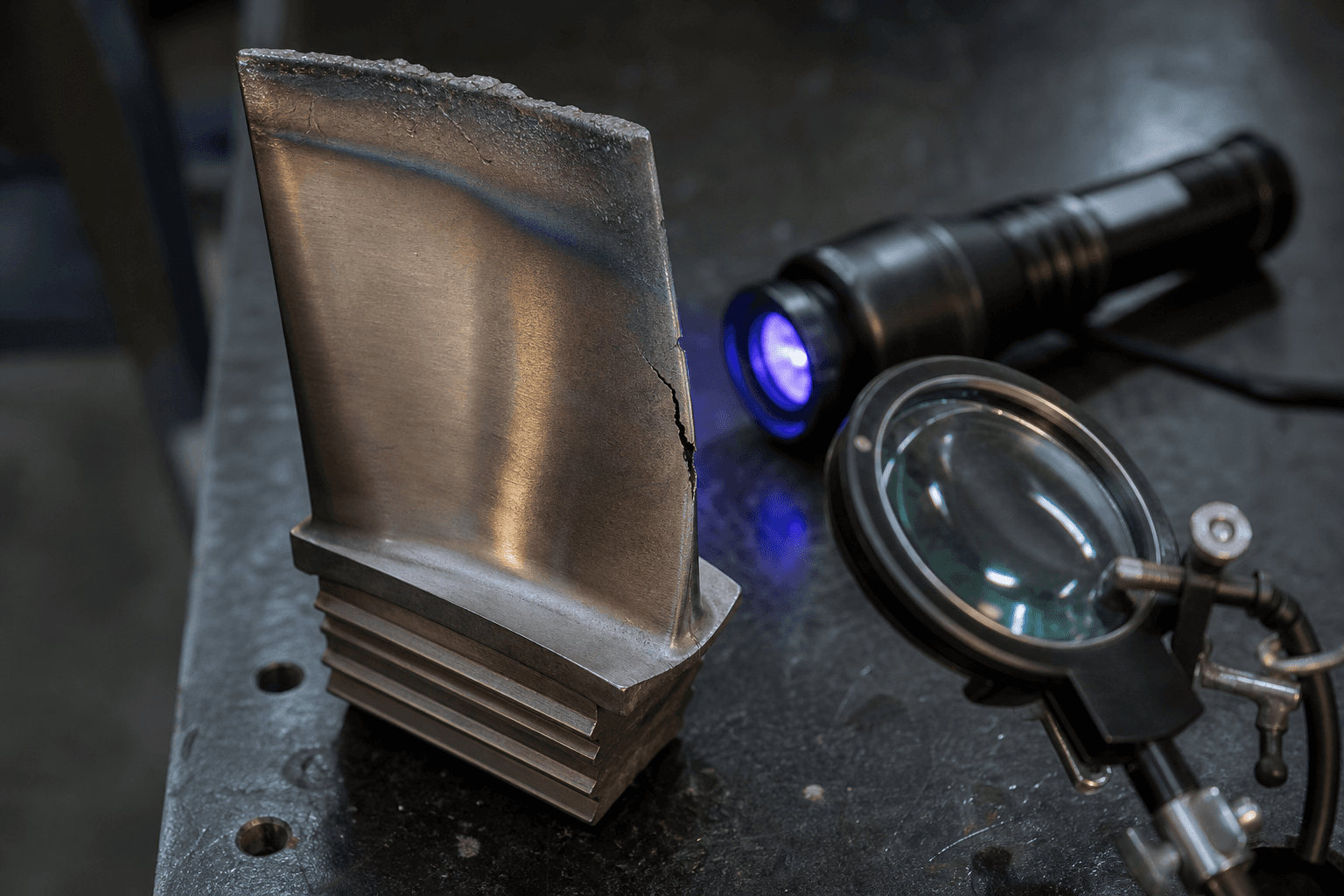
Result 1 — Repair and recoat inside a written limit
This is the job when geometry and coating can come back inside a published limit: tip restore, blend, an allowed weld, strip and recoat. You get a workscope that names the zone in millimetres, the remaining-wall minimum, and the scrap gate. You do not get “درست میشود” on the phone. NDT is run before any weld so the bead is not laid on an unmapped crack.
A foreign-object nick on the airfoil is often this door if the nick is shallow and away from the root. A root crack is usually not. Oxidation and thermal-barrier spall are this door when the substrate wall is still thick enough. Euroturbine writes the limit before metal is cut. That paper is what you file with the outage report.
Case. An SGT-600 power-turbine blade has a small leading-edge nick and coating loss, wall inside limit, interlocking shroud intact. Euroturbine writes blend plus recoat. The same row with a crack into the fir-tree is not result 1. That line waits for result 3.
Result 2 — HIP when internal voids dominate and the wall is still there
HIP closes internal voids when remaining wall is enough and the alloy is a candidate. It is usually paired with recoat. It is not a cheaper new blade and it is not a weld. After HIP, write the recoat process and thickness on the same certificate as the serial. A HIP cycle without a later NDT and CMM check is an unfinished ticket.
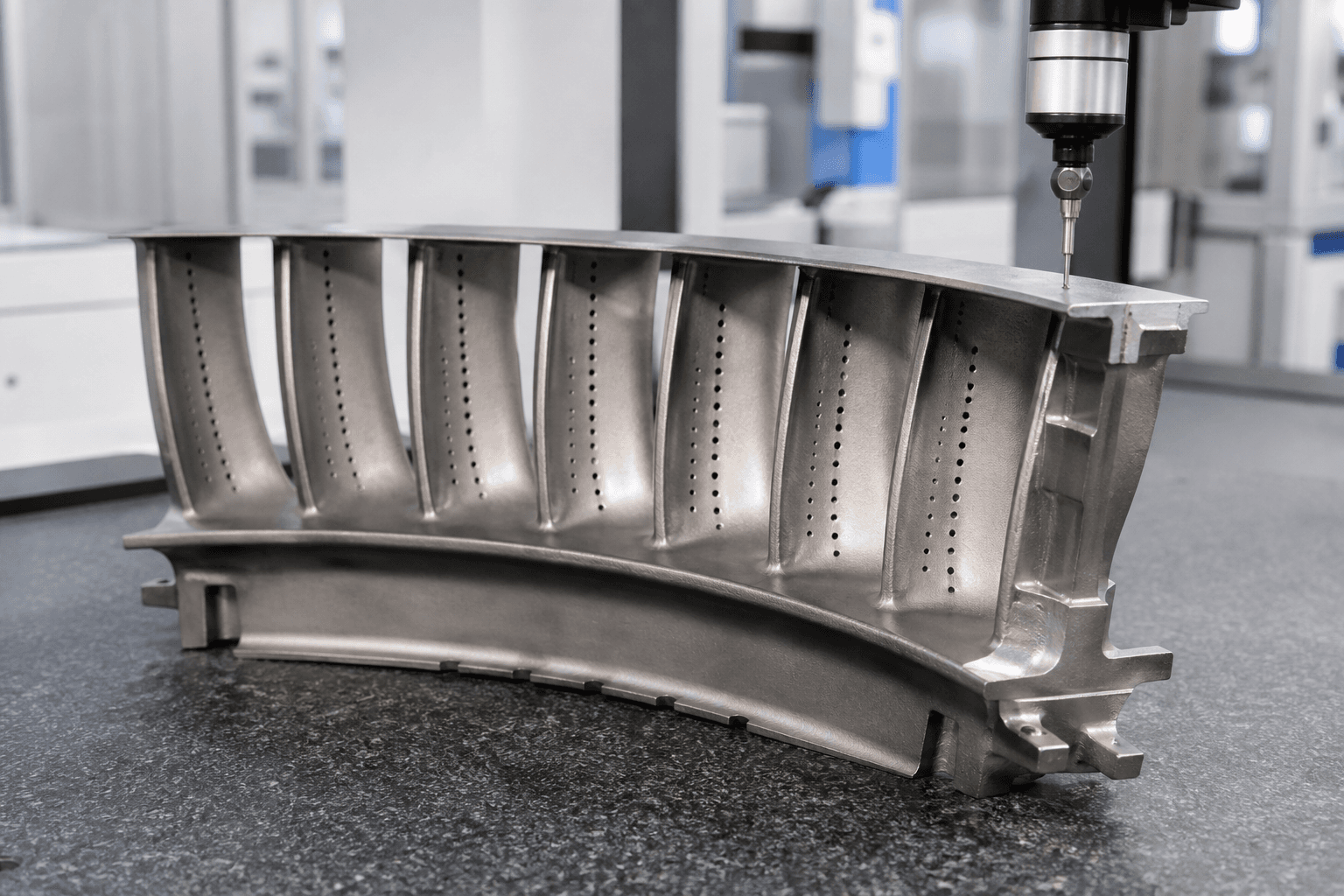
CMM after HIP and coat confirms the fir-tree still matches the disc drawing. HIP can move dimensions if the cycle is wrong for the grain. Euroturbine will not release a HIP row on a furnace chart alone. The coordinate-measuring machine file and the NDT report sit in the same pack as the HIP certificate.
Case. First-stage 9E buckets show internal porosity, wall inside limit, no root crack. Euroturbine writes HIP plus recoat and a CMM week after the coat. A V94.2 vane on the same purchase order with a surface crack in a forbidden zone is not added to that furnace. Result 2 is voids. A crack in a forbidden zone is result 3.
Result 3 — New-make when the root or remaining wall cannot be defended
New-make replaces the serial when remaining life or geometry cannot be defended: a root crack, wall below minimum, cooling that will not pass airflow. Pouring a neighbour geometry and stamping the old OEM number is not new-make. Euroturbine quotes a named pour with CMM and NDT in the same conversation as the date.
Mixing result 1, result 2 and result 3 in one rotating stage is possible only if engineering signs mass and coating. Without that signature the row is the next vibration trip. The store cannot make the mix legal by putting three doors on one pallet tag.
Repair scope · HIP · New-make
Case. A 9E stage-1 row has four buckets with root cracks, eight that are HIP candidates, and the rest repair-and-recoat. Euroturbine writes three workscopes and one engineering note if the repaired and HIP airfoils will sit next to new serials. If mass cannot be matched, the honest job is wait for a matched new-make set on the cracked four — not ship tonight and hope.
A cheap weld on the wrong crack is more expensive than a new blade. It fails in the next run.
What to send so the decision is written
Photographs of suction and pressure sides and the root. The last NDT report, fired hours and starts, and the OEM number. Euroturbine returns repair, HIP or replace with a workscope — not a verbal «احتمالاً خوب است». If you can, mark where each crack starts and where you think it stops. That mark is worth more than a second phone call.
RLTA · RCFA · Send photos
Case. A V94.2 group sends those photos, the OEM lines and a penetrant report from the last outage. The written door comes back in the same week. A sister request that only says «ترک بلید، قیمت جوش» waits until someone names the zone and the remaining wall. The weld was never the first question.
Frequently asked questions
Can every cracked blade be welded?
No. Location, alloy, crack length and remaining wall decide. Some cracks are scrap on sight.
Does coating loss always mean replace?
Not always. Strip and recoat is common if the substrate is sound. RLTA tells you if the metal underneath still has hours.
Who writes the repair limit?
Euroturbine writes a workscope with inspection criteria before metal is cut. That document is what you file with the outage report.
Related Euroturbine pages
Get a written repair-or-replace note
Euroturbine engineering will name the mechanism and the door: repair, HIP or new-make.
Talk to engineeringMore articles

Last updated: August 29, 2026