Internal cooling
A first-stage blade often has channels inside the metal and rows of small holes on the surface. Cooling air from the compressor must pass through those holes or the alloy overheats. A dimensional machine can pass the outside shape while a core has shifted or a hole has blocked. The airflow bench is how you catch that before the blade sees fire.
On internally cooled stage-1 and many stage-2 blades, ask for a flow result against a band — not the sentence “سوراخها باز است”. A reverse-engineered blade must be tested the same way; if you copy a blocked sample you copy the failure. Uncooled rows are different. Some free power-turbine blades on SGT-600 have no internal cooling. Do not paste an airflow line onto every RFQ without looking at the part.
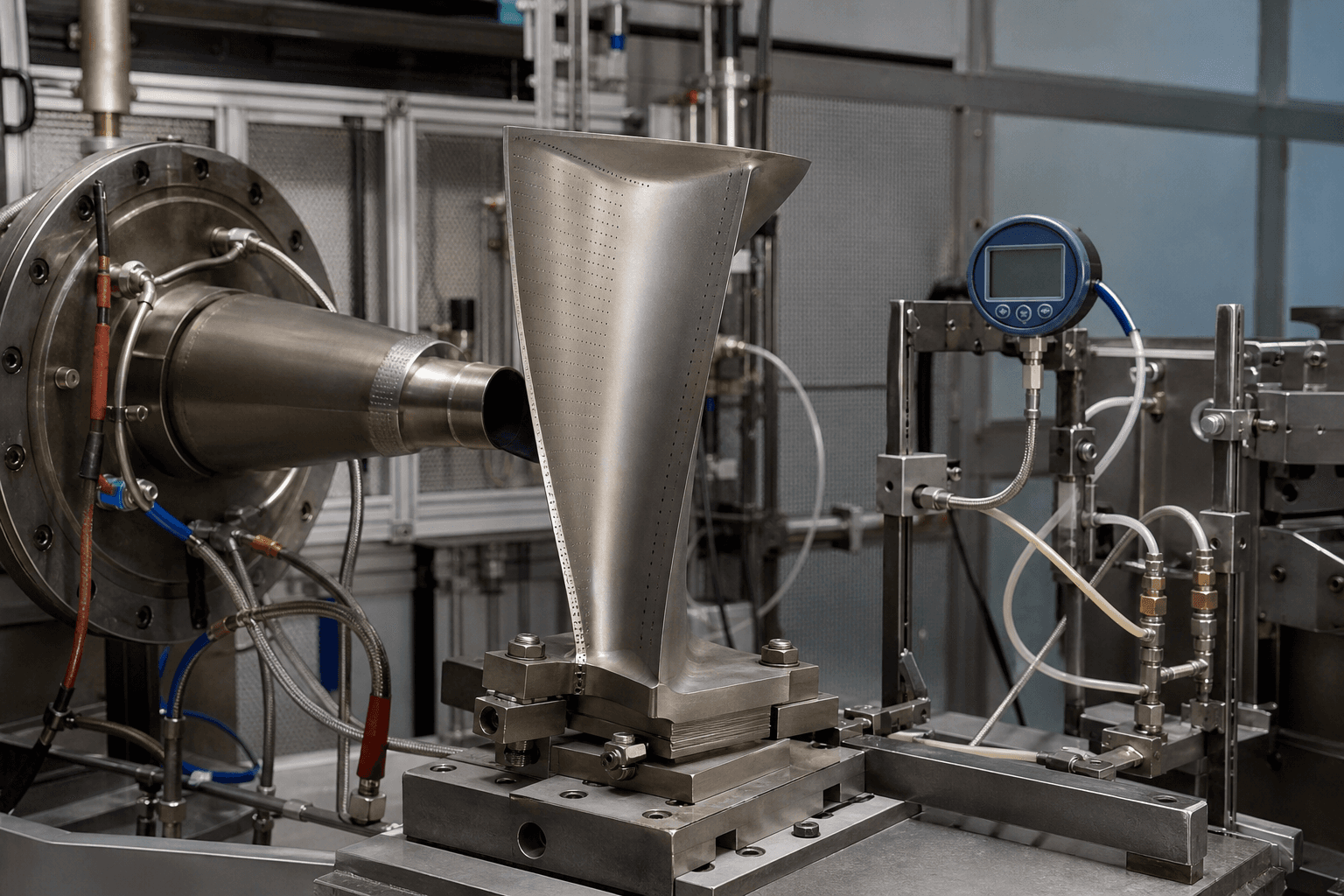
Result 1 — The blade passes the airflow band
The bench measures mass flow or pressure drop against a written band for that OEM number. If the number sits inside the band, Euroturbine files serial, band, pass, and ships. Case: a new-make first-stage 9E bucket after coating. Holes are open, flow is inside limit. The crate leaves with that sheet next to the CMM report. “سوراخها باز است” written by an inspector’s eye is not this result.
Result 2 — Clear the hole, then test again
A hole looks open on the surface and is blocked inside, or coating has closed a film hole. If remaining wall still allows, the shop clears that hole and runs the bench again. Case: a reverse-engineered V94.2 vane copied from a service-run sample; two film holes were half-closed in the sample. Clearing and retesting is the job. Copying the blocked sample and shipping it is how you buy the same overheat.
Result 3 — Scrap; cooling cannot be accepted
Flow stays outside the band after clearing, the core has shifted so a passage is gone, or wall is already below the repair limit. Euroturbine writes scrap for that serial. Uncooled rows are a different conversation: some free power-turbine blades on SGT-600 have no internal cooling. Do not paste an airflow line onto those RFQs. Do paste it onto every hollow first-stage blade, including reverse-engineered ones.
What Euroturbine files with the serial
The serial number, the test band (pressure or mass flow), pass or fail, and any hole that had to be cleared. When the specification asks for it, that record is tied to an X-ray of the cavity. Dimensional CMM and penetrant still sit in the same pack. This page is the cooling check. The other inspections do not replace it.
Frequently asked questions
Does every blade need an airflow test?
Only rows with internal cooling. Write on the request whether the part is cooled.
Can blocked holes be opened?
Sometimes. If the wall is already below the repair limit, the blade is scrap.
Do nozzle segments need the same test?
Cooled nozzle segments yes. Solid vanes no.
Related Euroturbine pages
If the row is cooled, put airflow on the quote
Euroturbine will not release a hollow blade because the holes “look fine”.
Request a quoteMore articles

Oxidation and Hot Corrosion on Blades: Two Different Damages, Two Shop Jobs
Emergency Hot-Gas-Path Parts When the Unit Is Already Down
Fir-Tree Blade Roots and Turbine Discs: The Blade Is Cast, the Disc Is Forged
Aftermarket Supply for a Legacy Siemens V93

Aftermarket Parts for a Siemens SGT-400 Oil-and-Gas Package
Last updated: August 29, 2026