Quality
A hot gas path part is not released because a photograph looks clean. It is released when the inspection pack matches the duty: surface cracks, internal voids, coating, and the geometry that has to stack in the machine.
NDT means non-destructive testing. Euroturbine writes the plan against the component, not against a generic turbine checklist. A hot-gas-path part is released when four inspections have each made a decision: FPI on the surface, X-ray on the casting, CMM on the stack, and a wall map where the duty is a liner or a thin duct. Those four results are written below. A photograph of a clean part is not any of them.
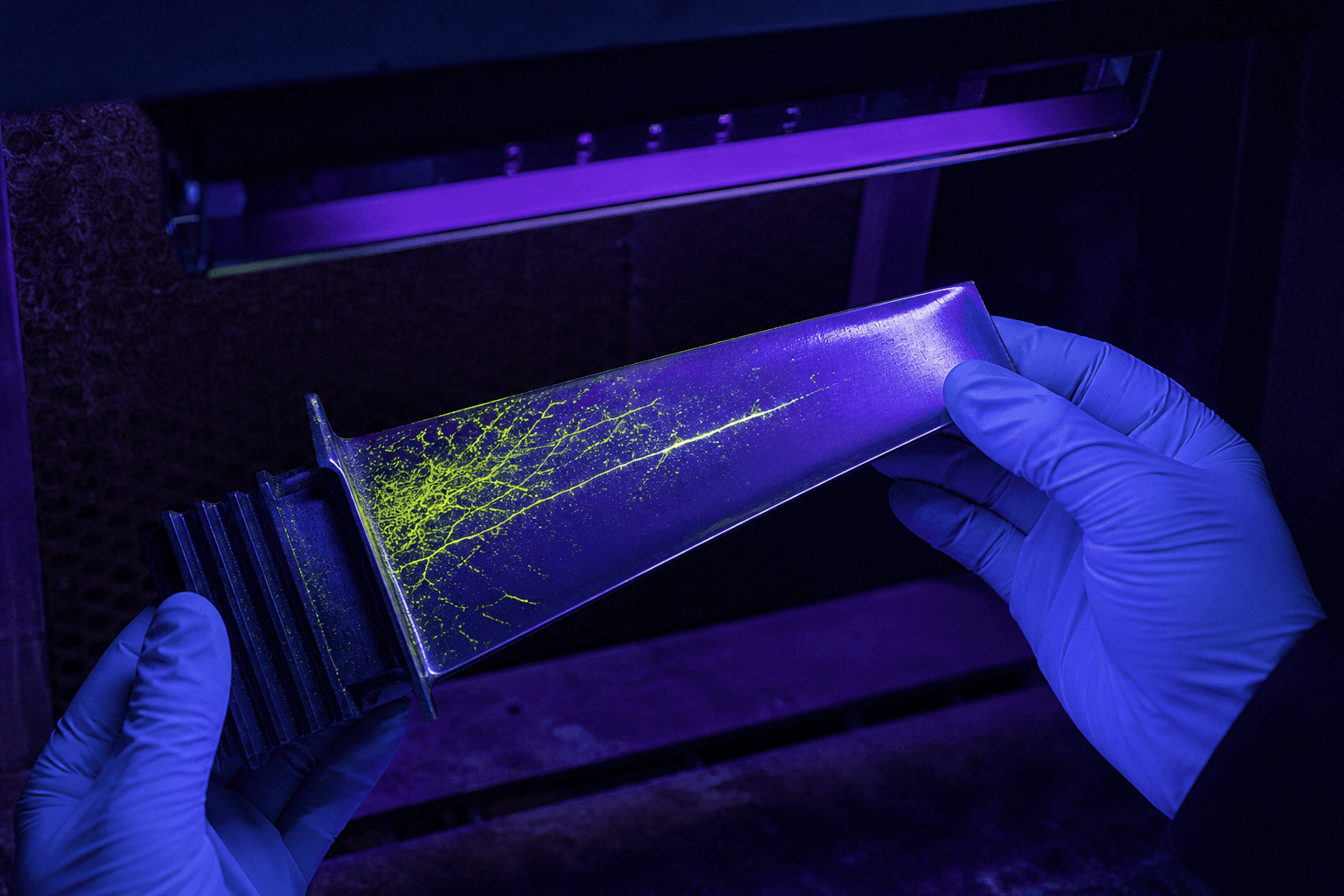
Result 1 — FPI decides surface cracks, not the inside of the casting
FPI is fluorescent penetrant inspection. Dye finds a crack that breaks the surface — leading-edge, trailing-edge, platform, fir-tree faces that you can wet. It does not see a void in the middle of a casting. Euroturbine will not release a first-stage blade or vane on FPI alone. A clean FPI on a hollow 9E bucket is one sentence. The next sentence is still X-ray.
Case. A V94.2 first-stage vane comes back from strip. FPI is clean. The plant asks to coat and ship. Euroturbine still runs volumetric inspection. A porosity cluster sits under a clean surface. That vane is not result 1 pass-and-forget. It is a HIP or scrap conversation. HIP means hot isostatic pressing. FPI had nothing to say about that cluster.
Result 2 — X-ray decides whether the casting is sound
X-ray — or an agreed volumetric equivalent — looks through the metal. On investment-cast first-stage hardware that is the decision for internal voids, shrink, and inclusions the dye cannot reach. Acceptance is against a written class, not against “به نظر خوب میآید”. The inspector level sits on the certificate next to the heat number. Repair hardware is mapped against the repair spec, then the restored zone is often X-rayed again before recoating.
Case. A new-make 9E first-stage bucket. FPI is clean. X-ray shows a void in the airfoil wall inside the HIP envelope, remaining wall still enough. Euroturbine writes HIP plus recoat, not ship-as-cast. If the void sits in a thin wall below the minimum, the decision is scrap that serial. X-ray is what split those two sentences. A sales PDF that says “NDT انجام شد” without the method and class is not result 2.
Result 3 — CMM decides whether the part will stack
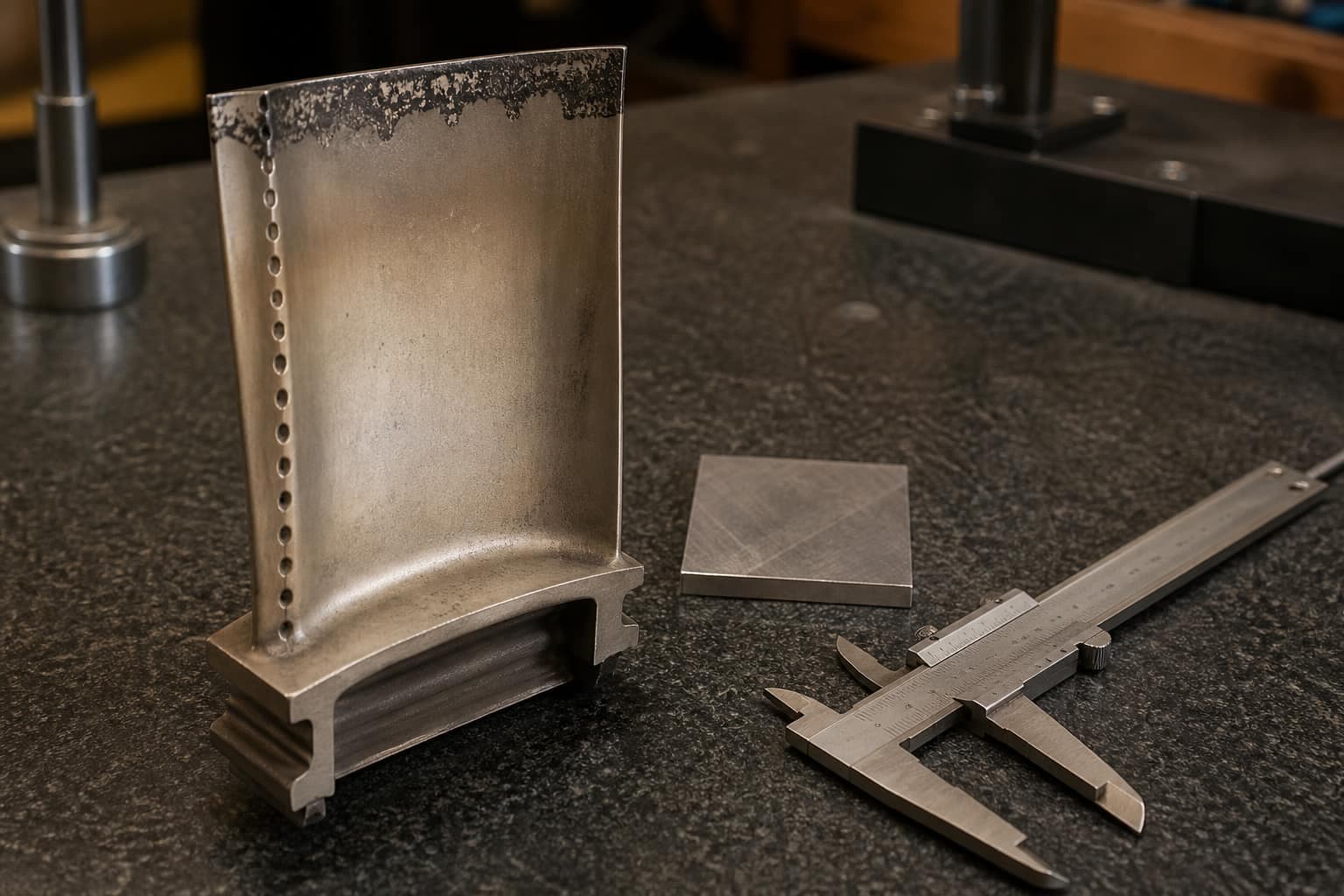
CMM is a coordinate measuring machine. It decides interchangeability: airfoil, root, throat, seal lands. A part that passed FPI and X-ray can still be fat in the throat or out on the fir-tree. That part will not drop in. Euroturbine puts a CMM extract in the same pack as the NDT sheets. Transition pieces need the duct and the seal lands measured, not only a photograph of the shell.
Case. An SGT-600 power-turbine blade, repair complete, NDT clean. CMM shows the root off the disk stack. Shipping it would have meant dressing on site or a vibration trip. Euroturbine holds the serial. Result 3 failed. Results 1 and 2 had passed. That is why the pack has three sheets, not one stamp.
Result 4 — Wall map decides repair versus scrap on liners
Combustion liners and thin transition ducts add wall-thickness mapping. FPI finds a crack at a cross-fire boss. It does not tell you the remaining millimetres next to that crack. A visual “it still looks round” is not an accept criterion. The wall map decides repair, a limited restore, or new-make. Bearings follow a different magnetic or ultrasonic route; they are not this result.
Case. A 9E liner set, flame face still coated. FPI shows a short indication at a cross-fire boss. The wall map next to that indication is below the repair minimum. Euroturbine writes new-make for that serial, not blend-and-hope. Another liner in the same crate has a clean wall and tired TBC — thermal barrier coating — and goes to strip and recoat. The wall map split the crate. The word “لاینر” did not.
Send the OEM part number — the original manufacturer number — and whether the set is new-make or repair. Euroturbine returns the inspection plan with the quote: which of the four results apply to that line. The plan does not arrive after the boxes. AOG — a unit that cannot start — still keeps these four results. Fast is not the same as uninspected.
Frequently asked questions
Is FPI enough to release a first-stage blade?
No. Surface FPI finds cracks that break the surface. Cast blades also need volumetric inspection (X-ray or equivalent) and a dimensional CMM against the stack. Euroturbine does not release first-stage hardware on FPI alone.
What should be on the certificate, not just in an email?
Heat number, NDT method and acceptance standard, operator level, coating spec if applied, and the OEM part number the piece is interchangeable with.
Can repaired blades use the same NDT as new-make?
The methods overlap; the acceptance limits differ. Weld or HIP hardware is mapped against the repair spec, then final FPI and often X-ray of the restored zone before recoating.
Ask for the inspection plan with the quote
Euroturbine releases HGP hardware with material and NDT certificates tied to the piece.
Request a quoteMore articles
Equiaxed, Directionally Solidified and Single-Crystal Blades: Three Different Products

Aftermarket Parts for ABB GT13D and GT13E2
Hot-Gas-Path Parts for the GE MS5001 Frame 5

Oxidation and Hot Corrosion on Blades: Two Different Damages, Two Shop Jobs
IN738, IN738LC and IN939 Turbine Blades: What the Alloy Grade Specifies
Last updated: August 29, 2026