Procurement
Plant buyers searching for gas turbine blades, nozzles and transition pieces usually face one commercial question: buy from the OEM, or from a qualified non-OEM manufacturer. The useful comparison is not brand name versus a cheap copy.
Euroturbine supplies aftermarket hot-gas-path hardware — blades, vanes, liners — for GE, Siemens, ABB, Mitsubishi and Zorya fleets. OEM here means the original equipment manufacturer, the name on the nameplate. A non-OEM part is defensible only when form, fit, alloy and inspection match the duty. A lower invoice is not that test. A reliability engineer should be able to put the data pack on the outage table and defend four named results: geometry, alloy heat, coating stack, and the NDT pack. NDT means non-destructive testing. Those four results are written below. The 9E buying case comes after them.
Result 1 — Geometry and CMM must match the stack
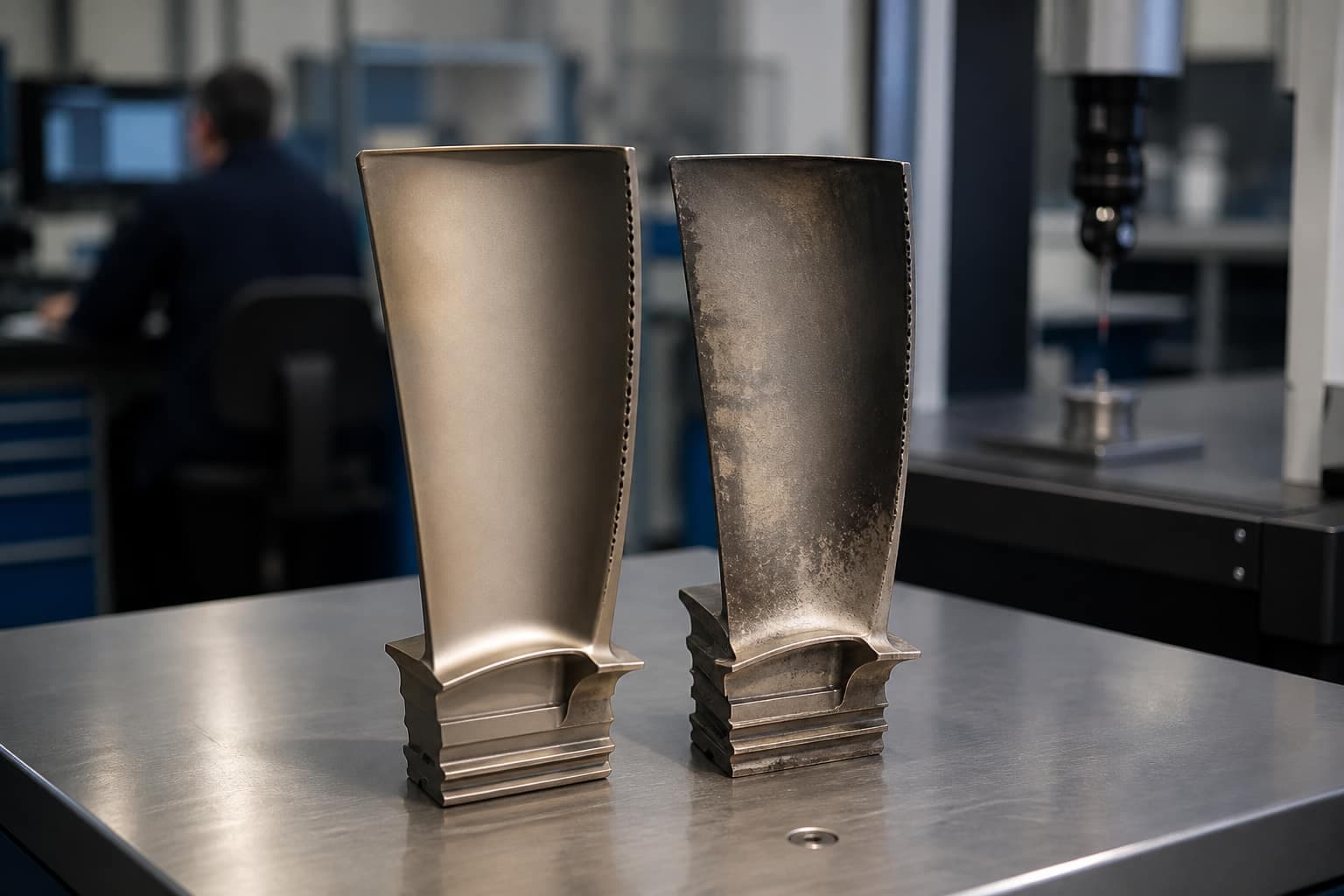
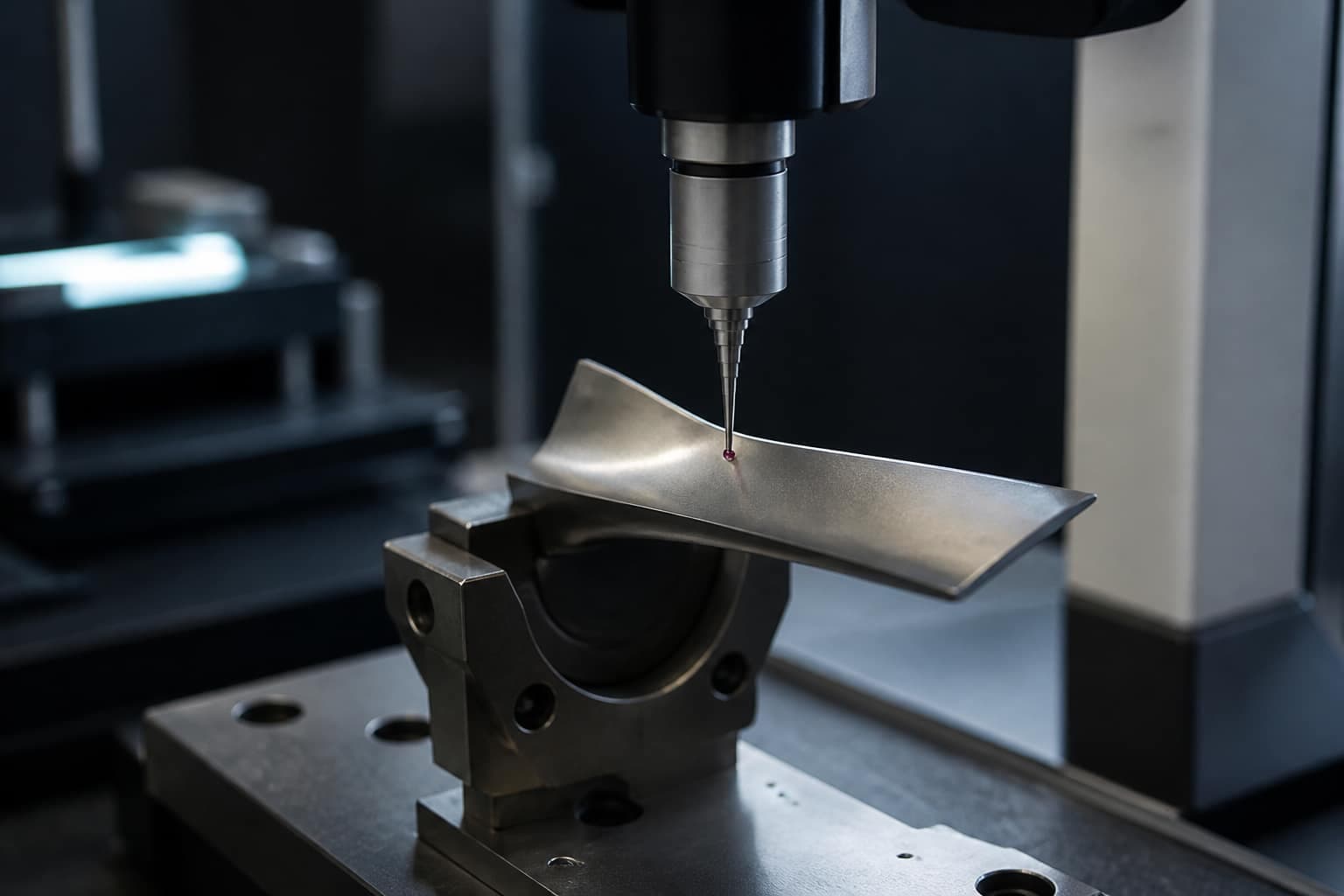
Dimensional interchangeability means the airfoil and the root sit inside the original stack-up. That is proven by CMM — a coordinate measuring machine — not by a photograph of a similar blade. If the fir-tree is out, the disk will not accept the part. If the airfoil is fat, the throat of the row changes and the machine runs off the performance map. Euroturbine will not call a part OEM-equivalent until the CMM extract for airfoil and root is in the pack.
Drop-in during a planned outage also means no casing machining on site. A shop that ships a “close” airfoil and asks the plant to dress the root is not supplying an equivalent part. The geometry result is pass or fail against the stack drawing you already hold, or against a scanned OEM sample when the drawing is locked.
Result 2 — The alloy heat must be the same grade as the stage
Material pedigree is a heat number that traces back to the casting house, and a grade that belongs on that row. First-stage 9E buckets are typically a GTD111 or IN738-class nickel superalloy. A vane on a cooler row may be a different melt. Writing “نیکل” on the certificate is not a grade. Euroturbine puts the heat number on the same sheet as the OEM part number so stores can file it against the row you actually run.
If the aftermarket melt is a cousin alloy — close chemistry, different specified strength or weldability — that is not silent substitution. It has to be written, and it has to match the duty of that stage. A cheaper heat that cannot take the firing temperature will not be cheaper after the first forced outage.
Result 3 — The coating stack must match firing temperature
The flame sees the coating, not the catalogue brand. TBC is a thermal barrier coating, the ceramic layer on the gas-path face. MCrAlY is the metallic bond and environmental layer under that ceramic, or on rows that never take ceramic. Some vanes still take aluminide. The mix follows firing temperature and the OEM row — not whichever powder the shop had that week.
A useful aftermarket line names the process, a thickness band, and whether a bond coat is required. A crate stamped “پوشش شد” with no thickness is not result 3. After HIP or weld restore the old coating is gone; the new stack still has to match the duty. HIP means hot isostatic pressing, a furnace under pressure used to close internal voids. Recoat is part of that job, not an optional extra.
Result 4 — The NDT pack must travel with the piece
NDT is not a brochure list. Surface FPI — fluorescent penetrant inspection — finds cracks that break the surface. Cast first-stage hardware also needs a volumetric look, usually X-ray, because a clean surface can still hide a void in the casting. The inspector level and the acceptance standard sit on the certificate, next to the heat number. Euroturbine does not release first-stage hardware on FPI alone.
The pack you file at the plant ties the heat number to the serial, names the NDT method and class, and maps the piece to the OEM number in stores. If TBC or MCrAlY was applied, that sheet sits beside the NDT sheet — not inside a sales PDF. Without that map, aftermarket is a box, not a spare you can defend.
A non-OEM part earns its place only when form, fit, alloy and inspection match the duty — not when the invoice is simply lower.
A 9E buyer comparing the OEM quote with aftermarket
Case. A combined-cycle MS9001E. The OEM quote for a first-stage bucket set arrives with a long lead time and a warranty line. An aftermarket quote arrives thirty percent cheaper, with a photograph of a blade and the word “equivalent”. No CMM extract. No heat number. No coating thickness. The outage meeting then becomes an argument about brand versus price. That is the wrong argument.
Euroturbine’s aftermarket paper is the third sheet on that table. Same OEM part number. CMM against the stack so the case does not need machining. Heat number back to the foundry. Coating process and thickness band. FPI plus X-ray plus the inspector class. Written interchangeability with the number already in your stores. Lead time on a well-characterised 9E row is often shorter than the OEM allocation, because the original manufacturer has deprioritised that line. Total cost is still piece price plus the days the unit stays open. A cheap box that fails result 1 or 4 costs the outage.
The OEM still wins on a warranty-bound upgrade and on the newest F-class cooling that has not been reverse-engineered. That is a different buying decision. For a standard 9E first-stage row, the useful comparison is the four results above, not the logo on the crate. AOG — the plant term borrowed from aviation for a unit that cannot start — is a separate commercial path when the window is already gone. It is not a reason to skip the pack.
Euroturbine documents aftermarket parts through a European foundry route with ISO 9001 process control, reverse engineering from an OEM sample when the frame is legacy, and full NDT and CMM before shipment. If the outage window is already short, say so on the same request. Priority delivery is a calendar on a slot that exists. It is not a reason to ship without the four results.
Frequently asked questions
Are non-OEM HGP parts the same as counterfeit parts?
No. A documented aftermarket part is manufactured to a controlled specification with material certificates and NDT. Counterfeit parts lack traceability. Euroturbine supplies the first category.
What should be in an aftermarket HGP data pack?
Alloy heat number, coating spec (TBC / MCrAlY / aluminide), dimensional CMM report, FPI or X-ray as applicable, and a statement of interchangeability with the OEM part number.
Which frames does this apply to?
The same checks apply to GE MS9001E and MS5001, Siemens V94.2 and V93, ABB GT13, Mitsubishi 701 series, and Zorya UGT-25000.
Related Euroturbine pages
Need interchangeability confirmed before the outage?
Send the OEM part number, frame, stage and quantity. Euroturbine will confirm interchangeability and quote new-make or repair.
Request a quoteMore articles

Repairing Inner Casings and Mixing Chambers After Long Service Hours
Buying Hot-Gas-Path Parts for a Siemens V94.3A
Heat Shields and Shroud Segments: The Stationary Ring Around the Blade Row
When a Cracked Turbine Blade Can Be Welded and When It Should Be Scrapped
Buying Hot-Gas-Path Parts for the GE MS6001B Frame 6B
Last updated: August 29, 2026