Repair limits
Welding is a process with a map, not a habit. The welder needs to know the alloy, how much wall is left, whether the blade has already been repaired, and exactly where the crack sits. A tip that has rubbed can often come back. A crack that runs into the fir-tree root usually cannot. Euroturbine would rather scrap one blade than send a hopeful weld into a rotating row.
Welding is allowed only inside a map. After an allowed weld the blade still needs the specified heat treatment, a new coating if the row is coated, and final NDT. Below are the three results Euroturbine actually writes. A phone sentence “جوش میزنیم درست میشود” is none of them.
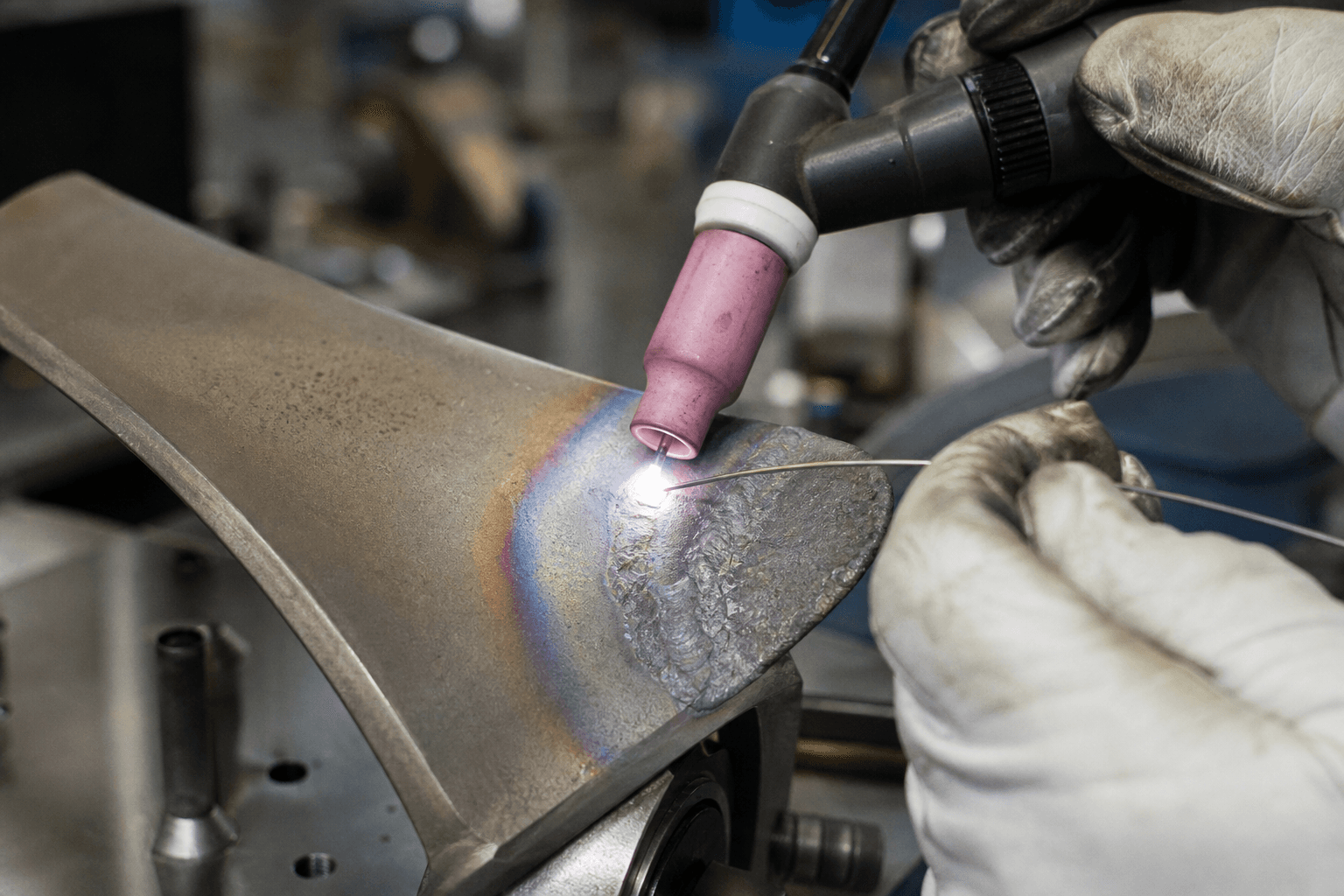
Result 1 — Weld or blend inside the allowed zone
This is the job when the damage is a rubbed tip inside the agreed height, a small nick on the airfoil that remaining thickness still allows to blend, or a trailing-edge repair the specification names. Fluorescent penetrant or X-ray comes first. Then TIG or blend, then heat treatment, then coating if that row carries a coating, then NDT again. Case: a 9E first-stage bucket with tip rub after a shroud rub. Height is still inside the restore envelope, root is clean. Euroturbine writes tip restore, not scrap.
Result 2 — Blend only, no added weld metal
This is the job when a nick is local, remaining wall is enough, but adding weld would put heat into a zone the alloy does not want. The shop blends to a drawn contour, measures, and releases. Case: a V94.2 vane with a small foreign-object nick on the leading edge, no crack into the platform. Euroturbine writes blend and inspect, not a weld bead.
Result 3 — Scrap, do not weld
This is the job when the crack is in the fir-tree root, a long crack runs toward the platform, the alloy has already used two weld cycles, or anyone wants to strike an arc before NDT. Sending that blade back with a hopeful weld is the next forced outage. Case: first-stage blade with a crack from the trailing edge into the root fillet. Euroturbine writes scrap and new-make for that serial. We would rather lose one blade than load a rotating row with a root weld.
What you file with the outage report
Before metal is added, Euroturbine issues a one-page workscope: which of the three results, the zone, the process, and the scrap gate. That page is what the reliability engineer keeps next to the outage report. Site welding of a running-stage root is not on that page unless we have signed it. Small site blending of a rub is a different sentence.
Repair, HIP or replace · NDT before any weld · Repair service
Frequently asked questions
Can every cracked blade be welded?
No. Location and remaining wall decide. A tip rub can be result 1. A small nick can be result 2. A root crack is result 3 — scrap — as soon as it is seen.
Is brazing used instead of welding?
On some stationary parts and on repairs that the specification names as braze. It is still a written process, not a field habit.
Can we weld stage-1 blades on the rotor at site?
Not without a workscope Euroturbine has signed. Site blending of a small rub is a different conversation from adding weld metal on a running-stage root.
Related Euroturbine pages
Send crack photos before anyone quotes a weld
Mark the OEM number and where the crack sits. Euroturbine will say weld, blend or scrap.
Request a quoteMore articles
Last updated: August 29, 2026