Vacuum pour, HIP, then inspect
If a vendor cannot name the wax pattern, the ceramic shell, the vacuum pour and the X-ray, they are selling a paragraph. A hot-gas-path blade is not milled from a bar the way many compressor airfoils are. It starts as wax, often with a ceramic core for cooling, then a shell, then nickel poured where air cannot oxidise the melt. Many rows are HIP’d to close shrink porosity before the fir-tree is machined and the airfoil is coated. Euroturbine prices that route as a chain, not as the single word “cast”. Below are the gates on that chain — vacuum, HIP, radiography, CMM, airflow — each with a plant-style case, and a filled foundry request a buyer can copy.
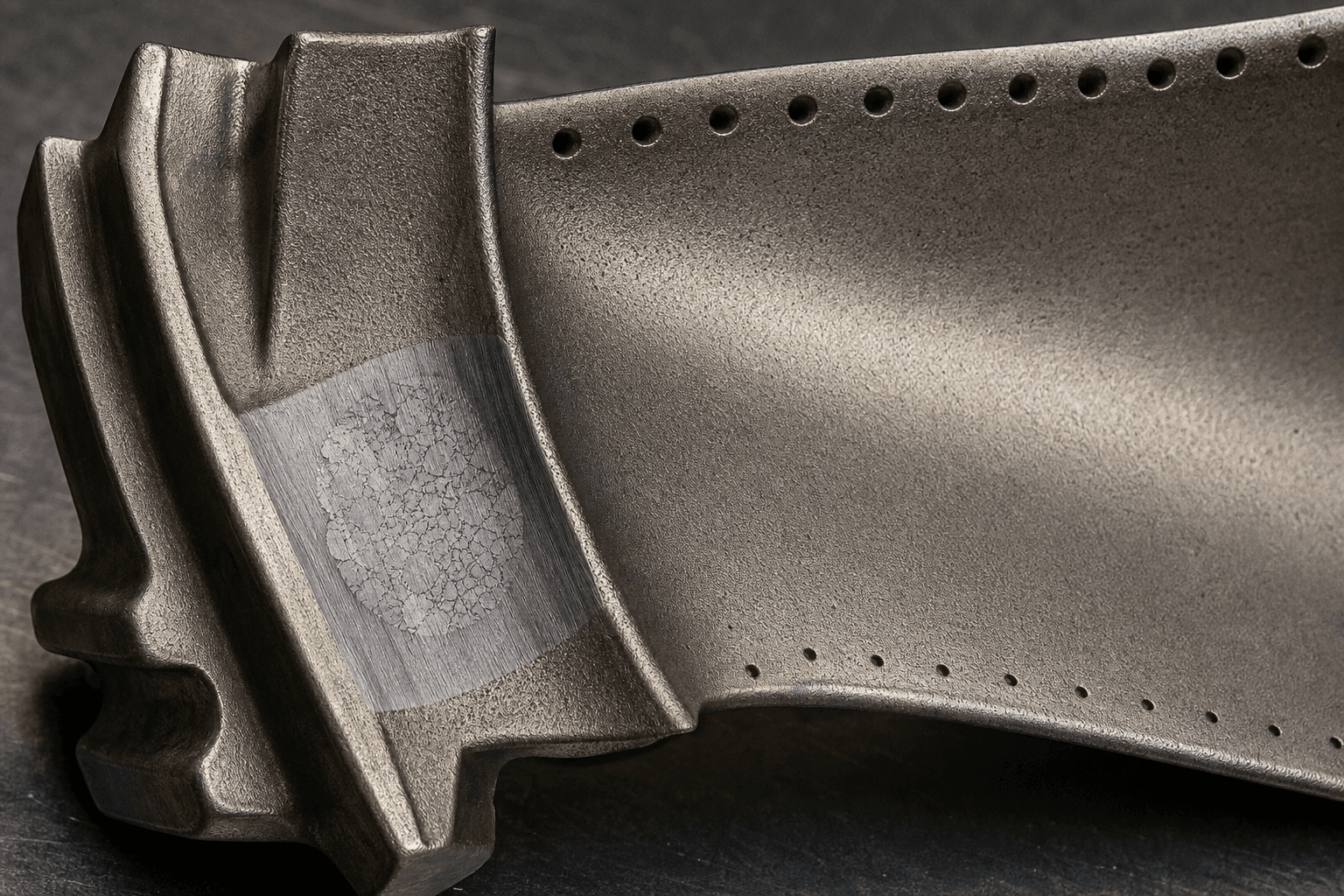
Investment casting begins with a wax pattern of the airfoil and root. If the blade is cooled, ceramic cores sit inside that wax so the metal later has internal channels. A ceramic shell is built around the pattern, the wax is melted out, and the shell is fired. The nickel superalloy is poured under vacuum so the melt does not oxidise or pick up nitrogen from air. After knockout, the casting is still only a rough shape: the fir-tree will be machined and the gas-washed surface will be coated. HIP — hot isostatic pressing — often sits between knockout and finish machining. Skipping any of those steps is how a pretty photograph becomes a part that does not survive the first interval.

Result 1 — A hollow first-stage blade must be poured under vacuum
Nickel superalloys used on first-stage blades oxidise quickly if they are poured in air. They also pick up nitrogen, which changes the inclusions and the later heat treatment. Vacuum is the quality gate, not a luxury line on a brochure. A mill certificate that never mentions vacuum on a hollow stage-1 row is not a foundry data pack. Euroturbine will ask yes or no on vacuum pour before the price is treated as comparable to another quote. OEM means the original equipment manufacturer; the vacuum question is asked against that OEM row, not against a generic “cast blade”.
Case A. A combined-cycle Frame 9E first-stage bucket is hollow. A vendor quote says “cast nickel” and never mentions vacuum. Euroturbine does not treat that price as the same product. We write vacuum investment-cast IN738LC (or whatever grade the last shop wrote), with the heat certificate naming vacuum. If the vendor later admits an air pour, the job is not a cheaper equivalent. It is a different metal.
Result 2 — After knockout, HIP equiaxed metal before the fir-tree is cut if that row says so
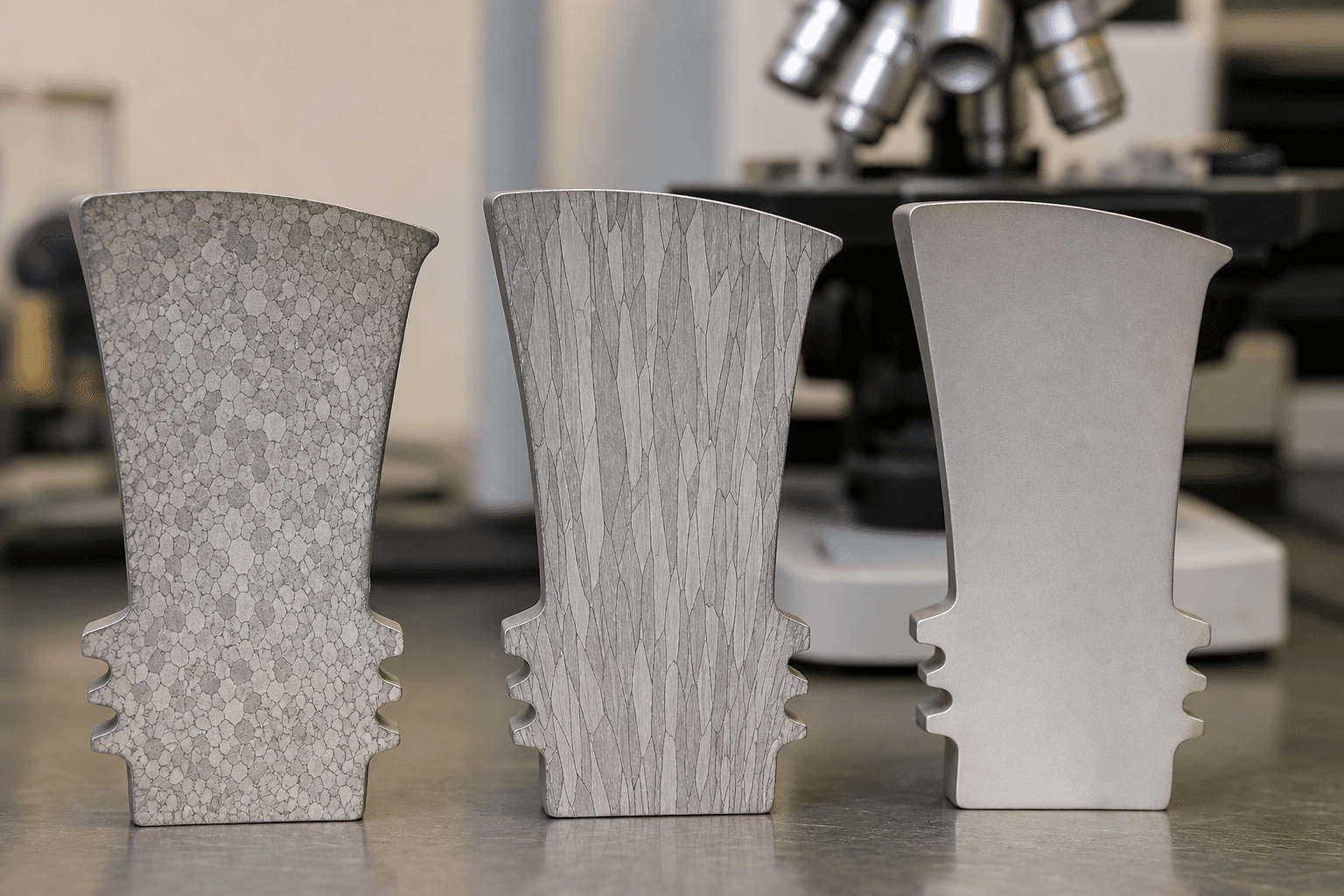
HIP is a furnace cycle under high gas pressure that closes shrink porosity left from solidification. Equiaxed means the grains grew in many directions during freeze. Many equiaxed hot-gas-path rows are HIP’d after knockout and before finish machining of the fir-tree. Ask whether the pour in front of you was HIP’d, and keep the certificate with the heat number. A blade that looks dense on the outside can still hide internal shrink if that step was skipped. Euroturbine will not treat a photograph of a shiny airfoil as proof of HIP.
Case B. A combined-cycle unit on V94.2 returns equiaxed first-stage blades for new-make. The last foundry certificate named HIP. Euroturbine writes HIP on the same line as vacuum pour, with the recipe that belongs to that equiaxed grade. The crate will not leave without the HIP certificate next to the heat number. A cheaper quote that skips HIP to “save the furnace week” is not the same blade.
Result 3 — Do not run the equiaxed HIP cycle on a DS or SX blade
Directionally solidified — DS — blades have long grains aligned with the airfoil. Single-crystal — SX — blades have no grain boundaries at all. Those structures have their own HIP temperature and pressure windows. Copying an equiaxed IN738 HIP cycle onto DS or SX is how a plant destroys the grain it paid for: recrystallisation, incipient melting, or a certificate that names HIP while the structure is already wrong. If the row is DS or SX, Euroturbine will not apply the equiax HIP paragraph. We either have a recipe for that structure, or we decline the furnace in writing.
Ask for the grain before anyone books the furnace. An etched scrap root or the last metallurgy note tells you whether the metal is equiaxed, DS or SX. Then ask whether a written HIP window exists for that grain. Frame 9E equiaxed HIP is a real recipe for that 9E row; it is not a default cycle you can paste onto a hotter nameplate. Without a defended window, Euroturbine writes no on the furnace rather than print HIP on a blade that has already lost the structure.
Case C. An inquiry arrives for a hotter row described as “single crystal, HIP like our 9E 738”. Euroturbine stops the sentence. Frame 9E equiaxed HIP is not an SX recipe. We ask for an etched scrap root or the last metallurgy note. If the structure is SX and we cannot defend a HIP window for it, we write no on the furnace. Honesty here is cheaper than a blade that looks HIP’d and has lost the single crystal.
A hollow first-stage blade needs radiography; a penetrant report is not enough
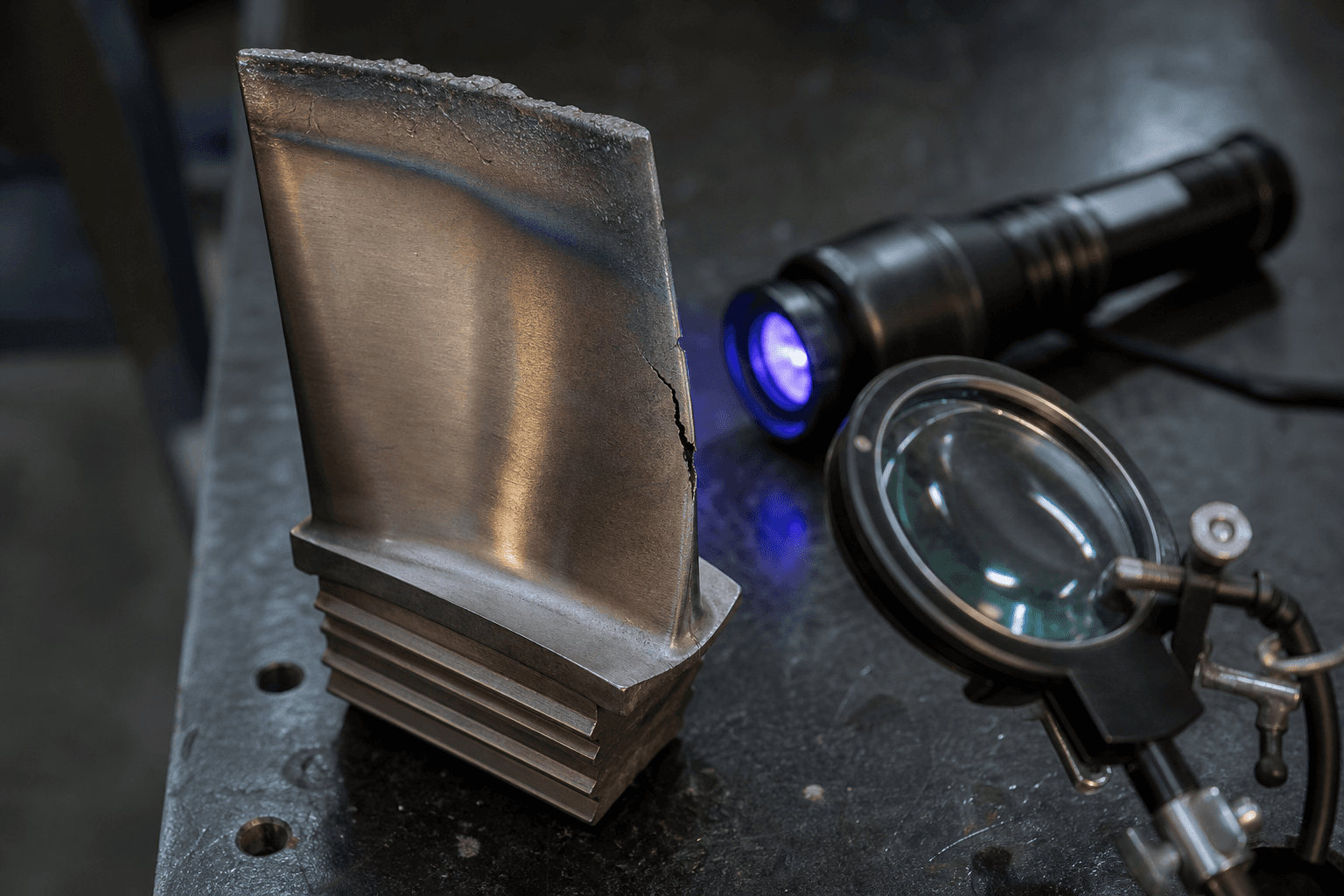
Radiography looks for internal defects the eye cannot see: shrink, core shift, a wall that is too thin between cooling passages. On a hollow first-stage blade, a mill paper without X-ray is not complete. Film or a digital report travels with the heat number. Euroturbine will not treat a fluorescent-penetrant report on the outside as a substitute for that look inside. Penetrant still belongs later, after machining; it does not replace radiography.
A hollow first-stage blade can pass a pretty outside shape and still hide a shifted core or a wall that is too thin between cooling passages. Those defects starve the trailing edge in fire. Put radiography on the same quote as the vacuum pour, with the film or digital report next to the heat number. Euroturbine will not release a hollow stage-1 crate on penetrant alone.
Case D. A Frame 9E combined-cycle first-stage hollow bucket arrives with a pretty penetrant report and no radiograph. Euroturbine does not release the part. We run radiography against the heat number, then decide. A core shift that passed the outside shape would have been a blocked cooling hole in service. That is why X-ray sits on the same quote as the pour.
The fir-tree root has to be measured; a photograph is not enough
CMM — coordinate-measuring machine — is a programmed check of the dimensions that have to enter the disc slot and sit in the gas path. Fluorescent penetrant finds surface cracks after machining; it does not prove the serrations match the disc. Euroturbine CMM’s the fir-tree against the OEM stack-up. A mill certificate without that programme on a rotating blade is still an incomplete pack. The airfoil can look perfect and still pinch or slop in the slot.
A shine photograph shows colour and a pretty trailing edge. It does not give the serration pitch, the neck thickness, or the lean that the disc slot expects. Those numbers come from a written CMM programme, compared to the unused OEM stack-up, with the report next to the heat number. If a vendor sends only a picture and a chemistry sheet, the crate is not ready. Euroturbine holds shipment until the programme closes, even when the airfoil already looks finished.
Case E. An SGT-600 station orders new rotating blades. The foundry sends a shine photograph and a chemistry sheet. Euroturbine holds shipment until the CMM programme on the fir-tree closes against the OEM numbers. If a used disc slot is already worn, that is a separate sentence — the CMM still has to show the blade was cut to unused stack-up, not to the wear on that disc.
If the blade is cooled, run an airflow test before you ship
If the blade is cooled, an airflow bench belongs in the same pack. A core shift or a blocked hole can pass a pretty outside shape and still starve the trailing edge in fire. The test is a flow number against a limit, not a sentence “holes look open”. Euroturbine will not skip airflow on a hollow stage-1 because the radiograph was clean. The two inspections answer different questions.
Write the row limit on the request and keep the bench number next to the serial. Radiography asks whether the core sat in the right place; airflow asks whether gas can still leave through the holes after the pour and the coat. A clean film does not prove the holes are open. Euroturbine ships a cooled row only after the bench closes, or after failed serials are scrapped or reworked as the specification allows.
Case F. Frame 9E first-stage hollow buckets, new-make. Radiography is clean. Airflow on three serials is below the row limit. Euroturbine does not ship the row. The cores are reviewed, the failed serials are scrapped or reworked as the specification allows, and the pack is retested. A crate of pretty, under-flow blades is not a foundry success.
Do not book a turbine-blade foundry for a milled compressor airfoil
Compressor blades that are only milled from bar or a forged preform skip wax, shell, vacuum pour and HIP. They are a different product and a different shop visit. Name the section of the machine before you ask for a foundry slot. Almost all first-stage hot-gas-path blades are cast. Some later turbine rows or compressor parts are forged or machined. Mixing the two on one RFQ is how purchasing books a foundry for a part that should have gone to a mill, or the other way around.
A foundry slot booked for “blades” will wait on wax and a vacuum pour that a compressor airfoil never needed. A mill booked for a first-stage turbine bucket will never produce a hollow cooling core. Write compressor or hot gas path on the first line, then the stage. Euroturbine splits a mixed list before anyone reserves a mould or a cutter. That split is the quote, not an extra email after the outage has started.
Case G. A Frame 9E station sends one RFQ titled “blades” covering compressor row 1 and turbine stage 1. Euroturbine splits it. Turbine stage 1 is vacuum investment-cast, HIP, coat, radiography, CMM, airflow. Compressor row 1 is a mill or forge route with its own inspections. One foundry slot for both would have been the wrong shop for half the list.
Do not pour a worn sample at the worn thickness
A worn sample can start a new-make only after the unused geometry is rebuilt. The scan is the first measurement. The manufacturing model is the part before wear: trailing-edge thickness restored, cooling holes inferred from a sister blade or from remaining-life logic, not copied blocked. Then this foundry chain starts — wax, shell, vacuum, HIP if specified, machine, coat, inspect. Pouring whatever the scanner saw pours the wear: a thin edge and a blocked hole that look “just like the sample”.
Case H. An SGT-600 station sends one eaten first-stage blade and asks to “cast the same”. Trailing edge is thin, two holes are blocked. Euroturbine scans, rebuilds unused thickness from a sister part in the same row, designs the core without copying the blocked holes, then runs vacuum pour, HIP, machine, coat, CMM, airflow. If remaining wall cannot support a rebuild, we refuse the pour in writing. That refusal is part of the foundry service.
A filled foundry request a buyer can copy
Copy this block. Frame: MS9001E (Frame 9E). Section: turbine hot gas path, not compressor. Stage: 1 rotating, hollow, cooled. Grade: IN738LC from last shop ticket. OEM number: [number]. Quantity: one full row. Outage: [month year]. Pour: vacuum investment-cast, ceramic core. HIP: yes, equiaxed recipe, certificate with heat number. Machine: fir-tree to OEM stack-up. Coat: last stack in full. Inspection: radiography with heat number, fluorescent penetrant after machine, CMM of fir-tree, airflow bench with the row limit. If the start is a worn sample: unused geometry rebuilt, not worn thickness poured. Vacuum yes or no must appear on the mill paper. A sentence “ساخت پره” is not this block.
Euroturbine returns the same block filled: vacuum yes, HIP certificate with heat number, CMM of the fir-tree, radiography, airflow if cooled, ship date. An email that only says “ساخت پره، فوری” is not a foundry request. If the start is a worn sample, say so on the first line so the unused geometry is rebuilt before wax is cut.
Buy the foundry route: wax, shell, vacuum, HIP, machine, coat, NDT. A single sentence about “ساخت پره” is not that route.
Frequently asked questions
Is every hot-gas-path blade cast?
Almost all first-stage HGP blades are vacuum investment-cast. Some later turbine rows, and many compressor airfoils, are forged or machined from bar. If the RFQ does not say which section of the machine, you will buy the wrong shop.
Why vacuum instead of an air pour?
Nickel superalloys oxidise and pick up nitrogen in air. That changes inclusions, heat treatment and later life. Vacuum is the quality gate on a first-stage blade, not a premium option you can drop to save a week.
Can you cast from a worn sample?
After reverse engineering back to the unused geometry — not by pouring the worn thickness. The scan is the first measurement. The manufacturing model is the part before wear. Then the foundry route starts: wax, shell, vacuum, HIP if specified, machine, coat, inspect.
Related Euroturbine pages
Ask for the foundry chain on the same quote
Euroturbine will name pour, HIP, machine, coat and NDT together. Send the OEM number and whether the blade is cooled.
Request a quoteMore articles
Equiaxed, Directionally Solidified and Single-Crystal Blades: Three Different Products
IN738, IN738LC and IN939 Turbine Blades: What the Alloy Grade Specifies
Emergency Hot-Gas-Path Parts When the Unit Is Already Down
Hot-Gas-Path Parts for the GE MS5001 Frame 5
Gas Turbine Blade Damage: Repair, HIP or Replace
Last updated: August 29, 2026