Stationary hardware
If the crate says “vane” and the store counted single airfoils, the unit of measure may already be wrong. Stage-1 nozzles on heavy-duty frames are usually segments: one casting, several vanes, one pair of hooks. Because the part does not rotate, centrifugal creep is not the life limiter — oxidation, thermal fatigue, trailing-edge thinning and cooling-hole blockage are. Cobalt-base alloys show up for that reason even when the rotor next door is nickel. Euroturbine will not price “one پره” when the machine buys a segment. Below are the buying results — segment versus single, cobalt versus copied IN738, mixed throats, a cracked inner platform, Siemens and GE names — each with a plant-style case, then a filled request a buyer can copy.
A stationary vane turns and accelerates the gas onto the next rotor row. On many frames it is not sold as a loose airfoil. It is a segment with an inner and outer platform, hooks or rails, and two or more airfoils in one piece. GE language calls this a nozzle. Siemens language also uses Leitapparat for the stator apparatus. OEM is the original equipment manufacturer; the number you copy is the segment number, not a rotor-blade number. CMM is a coordinate-measuring machine; on this part it checks hooks and throat, not a fir-tree. Persian RFQs often say پره ثابت or وین and then count the wrong thing. Interchangeability is the hook and the throat, not only the pretty airfoil on the bench.
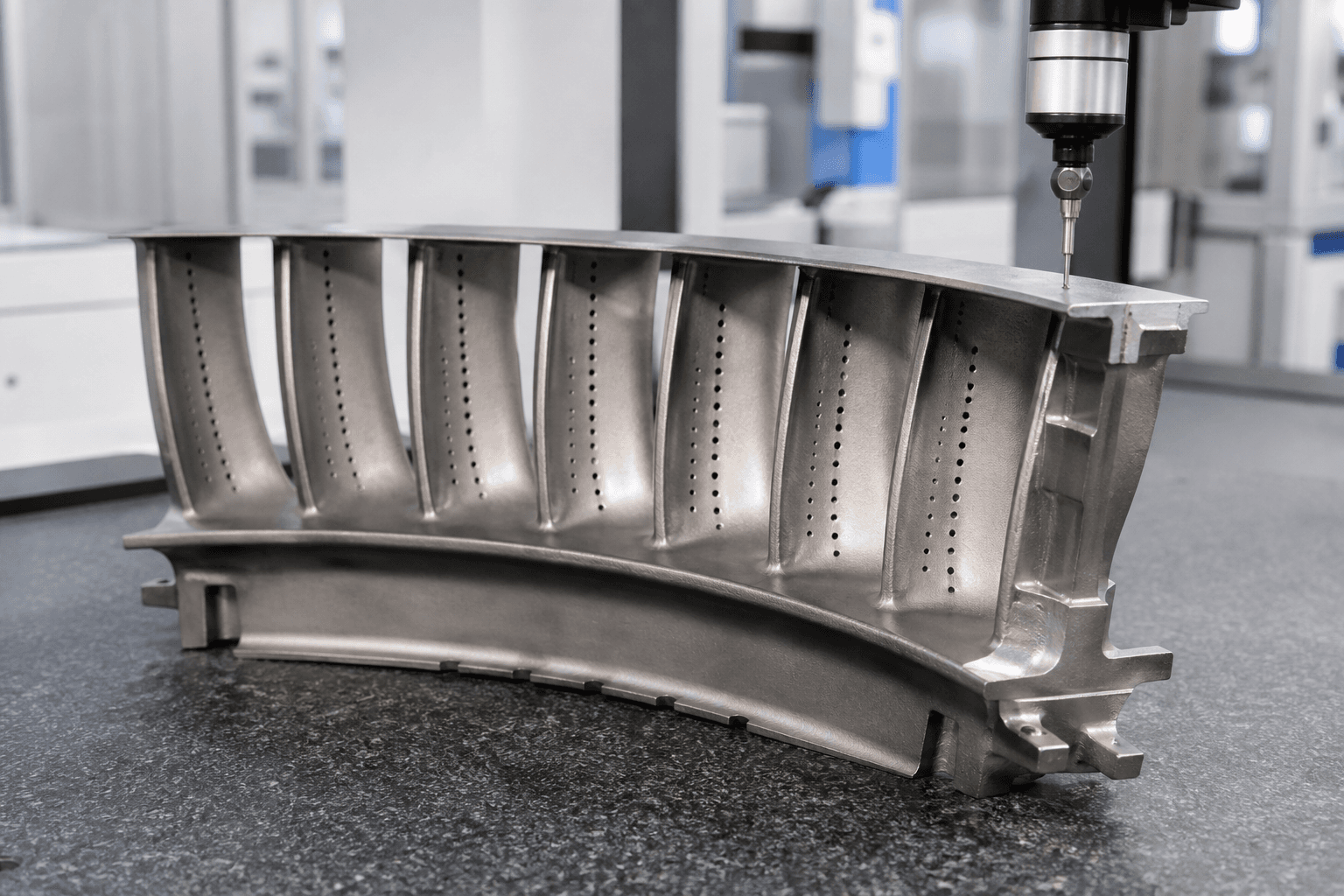
Result 1 — Order stage 1 as segments that close the circle, not as loose airfoils
Ask how many segments make a full circle on that stage, and write the OEM number of the segment — not “one vane”. First-stage hardware on E-class and V94-class machines usually arrives as one casting, several vanes, one pair of hooks. Ordering singles when the case uses segments leaves you with airfoils that have no hook and no throat as a set. Euroturbine will ask for the segment number and the count around the ring before the foundry slot is discussed. The unit of measure is the segment that closes the circle.
Case A. A combined-cycle Frame 9E unit asks for “۲۴ وین مرحله اول”. The machine buys a first-stage nozzle as segments; a typical ring is not twenty-four loose airfoils. Euroturbine stops and asks how many segments complete the circle and what OEM number is on the hook. We quote that count of segments, with CMM of hooks and throat. Twenty-four singles would have been the wrong crate on outage week.
Result 2 — A later stage can be single vanes; do not copy the stage-1 segment count
Some later stages do use single vanes. That does not make stage 1 a single. If the drawing shows one airfoil, one inner platform, one outer platform, and the count around the ring matches singles, write single vane and that OEM number. Copying the stage-1 segment habit onto a later row is how a plant receives a multi-airfoil casting that will not fit the later-stage hooks. Euroturbine names the stage before the unit of measure.
Case B. A V94.2 combined-cycle outage list mixes “نازل” for stage 1 and stage 3. Stage 1 is segments. Stage 3 on that nameplate is singles. Euroturbine writes two lines: segment OEM number and ring count for stage 1; single-vane OEM number and ring count for stage 3. One word نازل for both would have bought the wrong unit twice.
Result 3 — Do not copy rotor IN738 onto the nozzle; many stationary rows are cobalt
The vane sits in fire without spinning. Creep from centrifugal load is not the design driver. The metal has to survive oxidation, thermal cycling and a trailing edge that thins in service. Cobalt-base alloys are specified on many of those rows for that reason. Do not copy IN738 from the rotor onto the nozzle line because the two parts sit in the same case. Write the last shop’s alloy, or send a scrap segment for chemistry, before anyone talks about a substitute.
Case C. Combined-cycle V94.2. Rotor buckets are IN738LC. The nozzle crate is labelled Inconel because the store used one word for the outage. Chemistry on a scrap segment is cobalt-base. Euroturbine quotes the cobalt grade the last shop wrote, vacuum-cast as a segment, coating as last specified. The rotating 738 line stays on the bucket RFQ. One Inconel would have poured nickel into a cobalt row.
If the last note says IN939, write IN939; do not match the rotor 738
Nickel grades such as IN939 also appear on stationary parts where the OEM chose a different oxidation or hot-corrosion balance than a rotating 738 blade. IN939 is its own heat treatment and coating window. It is not a compromise spelling between cobalt and IN738. If the last note says IN939, write IN939. If it says cobalt, write cobalt. Euroturbine will not pick IN939 because the number is larger, or because the rotor is nickel.
Matching the buckets looks tidy on a purchase order and is the wrong duty. IN939 heat treatment, coating temperature and remaining-life logic stay with IN939 until engineering writes a substitute with chemistry evidence. Euroturbine will not move the segment line to IN738LC so the two rows share one alloy word. If the note is missing, a scrap segment goes for analysis before anyone talks about matching the rotor.
Case D. Frame 9E first-stage nozzle. Last metallurgy note: IN939. Purchasing wants IN738LC “to match the buckets”. Euroturbine keeps IN939 on the segment line. Matching the buckets would match the wrong duty. Chemistry, coating and remaining-life logic stay with IN939 until engineering writes a substitute.
Before you mix an aftermarket segment into a live row, measure the throat
A segment that looks like its neighbour on the bench can still change the gas angle or the heat load if the throat area is different. Coating thickness on the gas path changes the throat too. If you plan to mix an aftermarket segment into an existing row, throat area and coating have to be reviewed together. Euroturbine will say mix or matched set in writing. “It fitted the hooks” is not that review.
Measure throat area on a serviceable neighbour and on the new-make with the same CMM programme, then compare the coating stack. If the numbers close, write mixed row and put the measured throats on the pack. If they do not close, quote a matched set and do not leave the difference to outage-day fitting. A hook that accepts the segment is only the first check; the gas still has to leave at the angle that row was designed for.
Case E. Combined-cycle Frame 9E. Six segments in the first-stage ring are still serviceable; the rest need new-make. Euroturbine CMM’s throat area on a serviceable neighbour and on the new-make, and compares coating stack. If throats close, we write mixed row with the measured numbers on the pack. If they do not, we quote a matched set. We do not leave the mix to outage-day fitting.
Do not weld a cracked inner platform until the map says the zone is allowed
Location and alloy decide. A short crack in an allowed zone, remaining wall above the repair minimum, can be a written weld or blend, then heat treatment, then NDT — non-destructive testing: penetrant, and where needed ultrasonic or radiography. A creep-looking crack near the inner shroud on a V94-class vane is not that job until a workscope maps start and stop, remaining thickness, and whether the alloy has already used a weld cycle. Lighting a torch from a telephone description is how a crack is hidden and then opens in the next interval.
Case F. Combined-cycle V94.2, first-stage vane, crack from the inner platform toward the airfoil fillet, creep-looking. Euroturbine does not say “جوش میزنیم”. We want photographs with both crack ends marked, remaining wall if measured, hours and starts. If the map is outside the allowed zone or wall is gone, the line is replace the segment. If it is inside, we write weld or blend, furnace, NDT, and the scrap gate. The workscope is the document next to the outage report.
If the drawing says Leitapparat, you are still buying the nozzle row, not a rotor blade
If the drawing says Leitapparat, you are still buying the stator / nozzle apparatus, not a rotor blade. If the drawing says nozzle, you are still buying the stationary row. Siemens and GE used different words for the hardware that turns the gas onto the rotor. Translate the word on the RFQ so purchasing and metallurgy are looking at the same crate. Euroturbine maps the name to the OEM segment number before the pour. The word does not change cobalt versus nickel, and it does not change segment versus single.
Case G. A V94.2 station sends a drawing stamped Leitapparat and an RFQ stamped “blade”. Euroturbine answers on the stationary segment line: ring count, OEM segment number, alloy from the last shop, throat CMM. We do not pour a rotating fir-tree because the English RFQ said blade. The German word on the drawing already named the stator.
A filled stationary-row request a buyer can copy
Copy this block. Frame: V94.2 or MS9001E — name the nameplate. Stage: 1 stationary. Unit of measure: nozzle segment (not one vane). OEM segment number: [number on the hook]. How many segments complete the circle: [count]. Alloy: cobalt-base / IN939 / other, copied from last shop or from chemistry on a scrap segment — not copied from the rotor IN738LC. Cooling: yes or no. Last coating: [stack in full]. Mix into existing row: yes or no; if yes, throat-area CMM on a neighbour and on the new-make. Crack on inner platform: photographs with ends marked, or write none. Hours and starts. Outage date. Euroturbine prices the segment and the throat, not “a vane”.
Euroturbine returns segment count, OEM number, alloy, throat CMM, and mix-or-matched-set in writing. A crate labelled “وین” with no ring count is not this block. If the drawing says Leitapparat, it still maps to the same stationary line — not a rotor blade.
Quote the segment and the throat. “One vane” is how a plant buys the wrong unit of measure.
Frequently asked questions
Can I repair a cracked inner shroud on a stage-1 vane?
Sometimes. Location and alloy decide. Creep-looking cracks near the inner platform on V94-class vanes need a written workscope, not an automatic weld. Send photographs with the crack ends marked before anyone lights a torch.
Can aftermarket segments be mixed in one row?
Only with a review of throat area and coating. A segment that looks like its neighbour on the bench can still change the gas angle or the heat load if the throat is different. Euroturbine will say mix or matched set in writing.
What does Leitapparat mean?
It is the Siemens name for the stator / nozzle apparatus — the stationary row that turns the gas onto the rotor. It is not a rotor blade and it is usually bought as segments, not as loose airfoils.
Related Euroturbine pages
Send the segment number and how many make a circle
Write frame, stage, OEM segment number and cooling. Euroturbine will price the stationary row, not “a vane”.
Request a quoteMore articles
Equiaxed, Directionally Solidified and Single-Crystal Blades: Three Different Products

Buying Aftermarket Blades for a Siemens SGT-600
Fir-Tree Blade Roots and Turbine Discs: The Blade Is Cast, the Disc Is Forged

Oxidation and Hot Corrosion on Blades: Two Different Damages, Two Shop Jobs
Heat Shields and Shroud Segments: The Stationary Ring Around the Blade Row
Last updated: August 29, 2026