Planning
Outages slip when the parts conversation starts after the scaffolding is booked. Casting, HIP and coating each have a queue. Euroturbine’s aftermarket path only holds the date if the RFQ is early enough to sit in that queue.
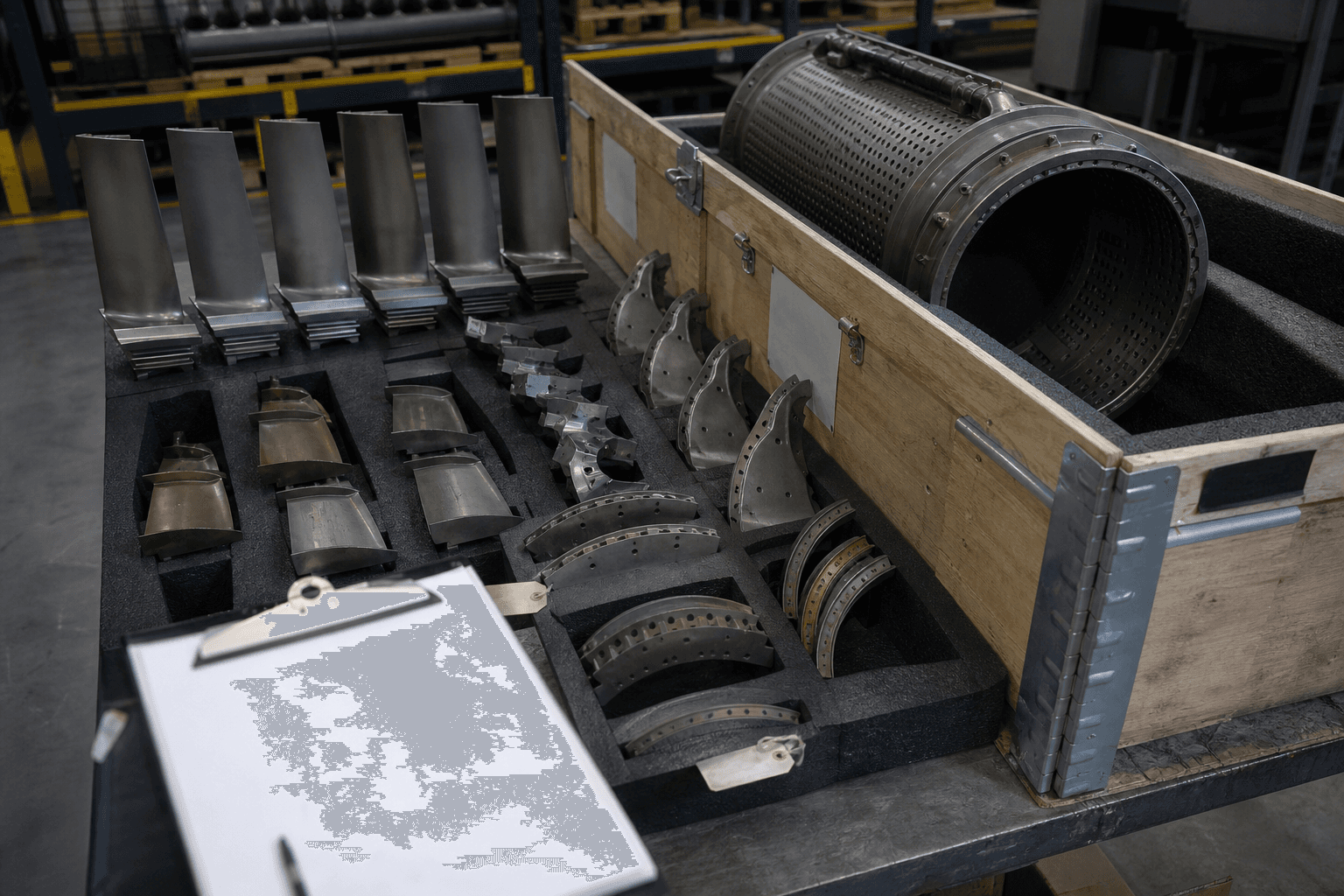
Count backward from the Monday the case opens. New-make hot-gas-path hardware needs a foundry slot, then coating, then NDT — non-destructive testing. Repair and HIP need incoming inspection first. HIP is hot isostatic pressing, used to close internal voids when remaining wall still allows it. If both streams feed the same outage, they must be one plan, not two vendors guessing. The four headings below are what you freeze in that week. AOG — the plant term for a unit that cannot start — is not the planning method for a date that has been on the wall for months.
Sixteen weeks out: freeze the bill of materials
This week you freeze which OEM numbers — original equipment manufacturer numbers — are on the outage, which frames sit on the critical path, and the quantities. Blades, vanes, liners, transition duct, seals and sleeve are separate lines. A family name such as “قطعات ۹E” is not a bill of materials. Photographs of worn samples belong here if the numbers in stores are messy. Euroturbine can reserve a foundry conversation only after those lines exist.
Case. A combined-cycle 9E with case-open in sixteen weeks. The plant sends “HGP set” and a date. Two weeks later someone adds transition seals. Two weeks after that the liner OEM number changes. The foundry slot that could have been held in week minus-16 is gone. Euroturbine treats week minus-16 as the freeze of the list, not as a soft start to a wish-list.
Twelve weeks out: lock new-make versus HIP per stage
This week you freeze the repair tree. Stage 1 new-make, stage 2 HIP, liners repair — or whatever the last NDT and remaining wall actually say. If remaining life is unclear, remaining-life assessment (RLTA) belongs now, not during case-open. A mixed row needs mass and coating family signed. Changing HIP to new-make after the vessel is booked is how you lose both the vessel and the foundry slot.
Case. A V94.2 first-stage vane set. Week minus-12 the last X-ray is still “somewhere in the archive”. The plant says HIP “احتمالاً”. Euroturbine will not book the vessel on that word. Incoming inspection or a written RLTA first. If the wall is sound and voids are internal, result is HIP plus recoat. If the wall is gone, result is new-make. That sentence has to exist twelve weeks out.
Eight weeks out: confirm coating and NDT capacity
The metal may already be in the foundry or in the HIP queue. This week you freeze the coating stack and the inspection plan. TBC or MCrAlY — thermal barrier or metallic bond — with a thickness band, not the word “پوشش”. NDT method and class on each line: FPI, X-ray, CMM, wall map as the part requires. CMM is a coordinate measuring machine. Coating booths and inspectors have queues. Discovering a missing thickness spec at week minus-two does not create a booth.
Case. An SGT-600 power-turbine row, pour already done. Week minus-8 the request still says “پوشش شود”. The booth asks TBC or MCrAlY and a thickness. Nobody answers for ten days. The crate misses the ship that would have held the date. Euroturbine puts the coating sheet next to the NDT plan at week minus-8, tied to the same OEM numbers you froze at week minus-16.
Four weeks out: freeze the packing list including liners and seals
This week you freeze what is actually in the crates: serials, quantities, liners, transition seals, cooling sleeves, nozzles, the paperwork pack. The last two weeks are site logistics — cranage, customs, the hall — not the week you discover a missing vane segment. If a line is still “بعداً میرسد” at week minus-4, it will not be on the Monday the case opens.
Case. A 9E outage, buckets and nozzles confirmed. Week minus-4 the packing list still omits transition seals and the liner set. Those lines were never frozen at week minus-16; they were assumed. The case opens. The duct is there. The seals are not. Euroturbine writes the packing list as the last freeze, not as a warehouse afterthought. If you need an LTSA — a long-term service agreement — around this calendar so the same numbers repeat, say so. The weeks do not change.
AOG is for a unit that cannot start. It is not the planning method for a scheduled overhaul.
Euroturbine can hold an LTSA envelope around this timeline so the same numbers repeat every outage. Or quote a one-off set. Either way, start with the date and the frozen list — not with a last-minute phone call that tries to buy back the four weeks you skipped.
Frequently asked questions
How far ahead should we RFQ new-make blades?
Treat 12–16 weeks as the planning floor for cast HGP, longer if coating capacity is tight. AOG exists for true emergencies; it is not a substitute for the annual outage buy.
When is HIP decided versus new-make?
When last NDT and remaining wall are on file, Euroturbine can split the set: HIP some stages, new-make others, one delivery. That decision belongs before the case is opened, not during.
What do you need on week minus-16?
Fleet list, outage week, OEM part numbers, quantities, and whether liners travel with the blades. Photographs of worn samples help if part numbers are messy.
Related reading
Put the next outage on a parts timeline
Share the week and the OEM numbers. Euroturbine will say what can be new-make, HIP or kit in time.
Request a quoteMore articles
How a Compressor Blade Differs from a Hot-Gas-Path Blade
Heat Shields and Shroud Segments: The Stationary Ring Around the Blade Row
Emergency Hot-Gas-Path Parts When the Unit Is Already Down
Hot-Gas-Path Parts for the GE MS5001 Frame 5

Repairing Inner Casings and Mixing Chambers After Long Service Hours
Last updated: August 29, 2026