Grain structure is the specification
Most Iranian E-class aftermarket is equiaxed metal in the IN738 family: many grains grew in many directions when the casting froze. Directionally solidified blades have long grains aligned with the airfoil to fight creep; single-crystal blades have no grain boundaries at all. Those three are different products, with different foundry control, HIP recipes and aftermarket case. Mixing the three names in one sentence is how a plant buys a pretty, wrong blade, and Euroturbine will not pour a single-crystal copy from an equiax request. Below each structure is its own result, then HIP, then GTD111, then a filled request — not three labels on one pour.
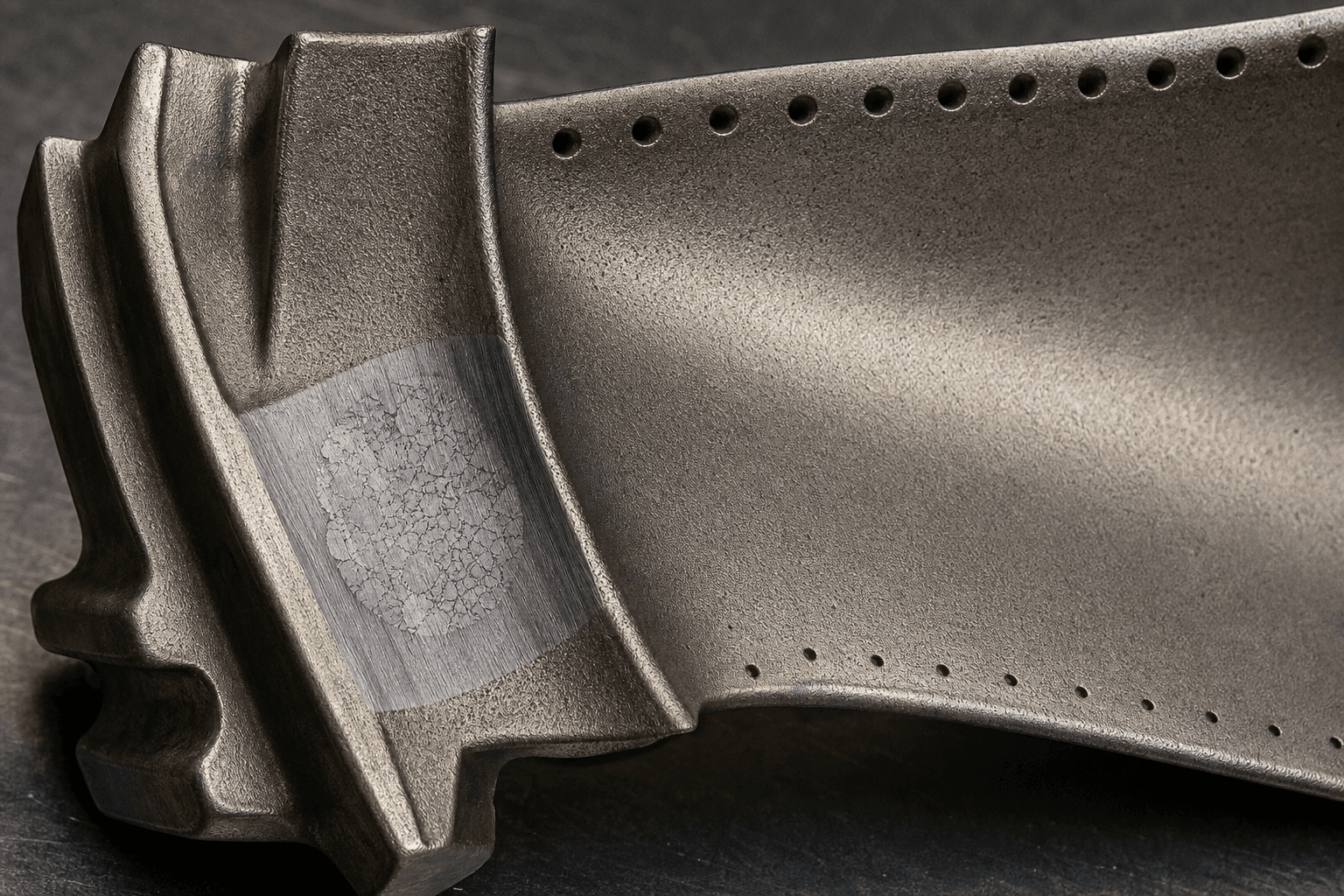
Grain structure is not a brochure adjective. It is how the metal froze, and it decides how the blade carries centrifugal load at temperature. Equiaxed — often written equiax — means many grains, many directions. Directional solidification, DS, lines the grains along the airfoil so grain boundaries are less of a creep path. Single crystal, SX, removes those boundaries. HIP is hot isostatic pressing; the recipe changes with the grain. OEM is the original equipment manufacturer; the structure has to match that number, not a capability paragraph. An etched scrap root answers faster than a slide.
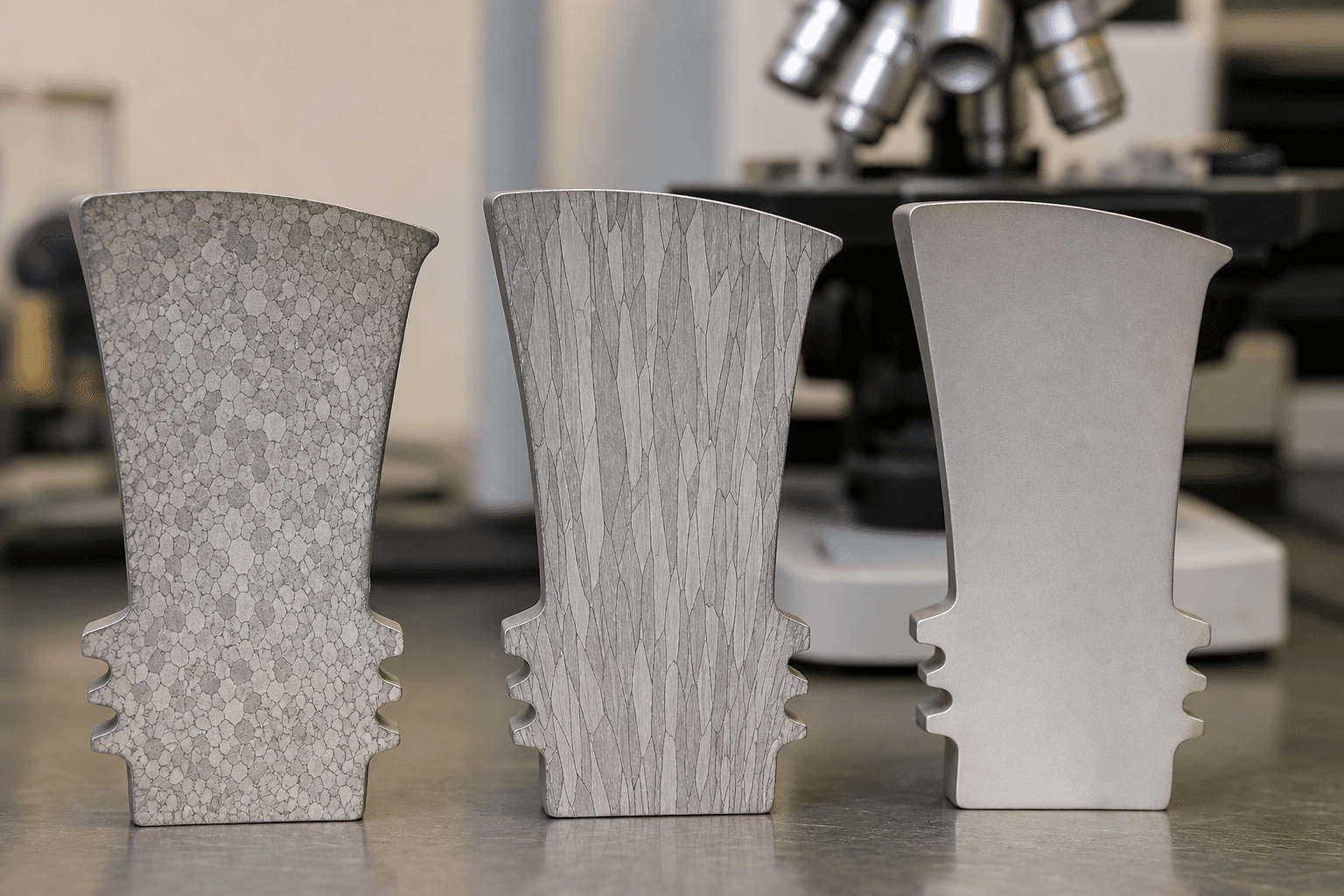
Result 1 — If the last shop wrote IN738LC and not DS or SX, order equiaxed metal
If the last shop wrote IN738 or IN738LC and did not mention DS or SX, the working assumption on Iranian E-class aftermarket is equiaxed. That is still a vacuum investment-cast blade with a real HIP and coating story. It is not “the cheap version of single crystal”. It is the product that row was designed around. Euroturbine quotes that new-make routinely when the OEM number and the grain match. Do not dress an equiax request in SX language to make the purchase look more advanced.
Case A. Combined-cycle Frame 9E, first-stage buckets, last ticket IN738LC, no DS, no SX. Euroturbine writes equiaxed vacuum pour, equiaxed HIP if specified, root machine, coat, inspect. Purchasing had asked for “single crystal equivalent”. We refuse that sentence. The creep case for that OEM number is equiax. An SX copy against a 9E 738 number is undefended metal.
Result 2 — Order a directionally solidified blade only if the last shop or the drawing wrote DS
DS exists on hotter rows and on some upgrades. The foundry has to control withdrawal, mould temperature and grain selection so the columns run the length of the airfoil. Grain boundaries still exist, but they are aligned so they are less of a transverse creep path. The aftermarket case is tighter than for equiax: the process window is narrower and a photograph of an etched root is easier to fake than a real DS pour. Write DS only if the last shop or the drawing wrote DS. Euroturbine will quote DS only after the sample or the drawing proves the structure.
Case B. A hotter row on a V94-class upgrade inquiry says “DS GTD111”. No etched root, no last metallurgy note. Euroturbine does not pour. We ask for a scrap root to etch, or the OEM process note. If the etch shows equiax, we quote equiax to the real structure and refuse the DS label. If the etch shows columns, we quote DS only with a foundry that can defend withdrawal control. A capability slide that names DS is not a structure.
Result 3 — If the nameplate row is equiaxed, do not order single crystal
SX removes grain boundaries. The foundry needs a seed, a withdrawal programme, and inspection that actually looks for stray grains and recrystallisation — not a brochure word. The aftermarket case is weaker than for equiax because the process is easier to claim and harder to prove. Euroturbine will quote SX only after evidence. If we cannot defend the structure from a sample or a drawing, we decline in writing. That is how a plant avoids a blade that cannot carry the creep case.
Equiaxed on the nameplate means the OEM number, the disc slot and the remaining-life logic were written for a mosaic of grains, not for a single crystal. Ordering SX against that number does not “upgrade” the row. It buys a blade whose creep path, HIP window and coating temperature were never proven on that disc. If someone truly specified an SX substitute, they send the seed, the withdrawal note and the stray-grain inspection with a signed engineering request. Until that pack exists, Euroturbine pours equiax to the existing number.
Case C. Purchasing on a Frame 9E combined-cycle unit wants “SX aftermarket” against the existing IN738LC OEM number. Euroturbine writes no. The number is equiax. We will pour equiax IN738LC, or we will open a separate engineering request if someone has actually specified an SX substitute with seed and inspection. Until that paper exists, SX language on a 9E 738 RFQ is a pretty, wrong blade.
Do not copy an equiaxed HIP cycle onto a DS or SX blade
Hot isostatic pressing closes porosity, but the temperature and pressure window is not copied from an equiax book onto DS or SX. An equiaxed IN738 HIP cycle that restored a 9E blade can recrystallise an SX blade or push a DS column into incipient melt. Defect maps differ too: what is allowed shrink on equiax may be scrap on SX. If the row is equiax, Euroturbine uses the equiax recipe and keeps the certificate with the heat number. If the row is DS or SX, we either have a written window for that structure, or we will not book the furnace.
The furnace looking the same is not a reason to reuse the recipe. Equiaxed metal can stand a HIP temperature that starts new grains inside a single crystal, or that locally melts a DS column. Pressure and hold time follow the same rule: they were written for one structure. Ask for the grain first — etch a scrap root or copy the last metallurgy note — then ask whether a HIP window exists for that grain. Without that window, a HIP certificate on a DS or SX row is only a furnace log, not a defended process.
Case D. Combined-cycle Frame 9E inquiry: “HIP our SX row like you HIP’d the 9E 738”. Euroturbine will not apply the 9E equiax HIP paragraph. We ask for structure evidence. Equiax: HIP with the equiax certificate next to the heat number. SX without a defended window: furnace declined in writing. Honesty is cheaper than a failed copy that looks advanced on a slide.
Write whether the GTD111 row is equiaxed or DS; the alloy name is not the grain
GTD111 exists in more than one process form. It is a nickel grade, not a synonym for DS. Some rows are equiaxed GTD111; some are DS. Write what the last shop wrote, or etch a scrap root. Do not assume DS because the alloy name is familiar from a hotter row, and do not assume SX because a neighbour frame uses SX. Euroturbine matches process form to evidence, not to the fame of the alloy name.
Grade and grain are two lines on the request. Write GTD111 only if the last ticket wrote GTD111, then still name equiax or DS. Do not change an IN738LC OEM number into GTD111 because the alloy is famous, and do not write DS GTD111 because a hotter neighbour used that pair. An etch on a scrap root from that row ends the argument faster than a catalogue heading.
Case E. RFQ says GTD111, “so it must be DS”. Etch on the scrap root from that Frame 9E-class row shows equiaxed grains. Euroturbine quotes equiaxed GTD111 only if that grade is actually what the OEM number wants — and still will not change an IN738LC number into GTD111 without a substitute paper. The etch killed the DS assumption in one shop visit.
What Euroturbine will pour, and what we will not
We quote equiax new-make when the row is equiax. We quote DS or SX only after evidence. If we cannot defend the structure, we decline in writing. That is not a capability gap dressed as caution; it is how a plant avoids a blade that cannot carry the creep case. Send the last metallurgy note or a scrap root. The answer will be equiax, DS, SX — or no.
Case F. Combined-cycle V94.2, first stage, etched root equiax IN738LC. Euroturbine books the equiax foundry slot. A second line on the same email asking for SX “if possible” is answered no on that OEM number. Two products are not one pour with two labels.
A filled grain request a buyer can copy
Copy this block. Frame: MS9001E (Frame 9E) or V94.2 — nameplate. Stage: 1 rotating. OEM number: [number]. Last shop grain: equiax / DS / SX, copied from the metallurgy note dated [date]. If unknown: scrap root attached for etch, do not guess SX. Alloy: IN738LC or as on the ticket — GTD111 only if the ticket says GTD111, and then still name equiax or DS. HIP: equiax recipe only if grain is equiax; DS/SX HIP only with a written window for that structure. Do not ask for SX against an equiax OEM number. Outage date, hours, starts.
Euroturbine answers equiax, DS, SX, or no — in writing — before a mould is booked. A scrap root in the same crate as the RFQ is faster than a capability paragraph. If the etch disagrees with the email, the etch wins.
Name the grain before the pour. Equiax, DS and SX are three products, not three ways to spell the same blade.
Frequently asked questions
Can HIP restore a single-crystal blade?
Only inside an SX temperature and pressure window, with an SX defect map. Do not apply an equiax HIP story to a single-crystal row. Euroturbine will say so before anyone books a furnace; if we cannot defend the window we decline in writing.
Is GTD111 always directionally solidified?
No. GTD111 exists in more than one process form. Write what the last shop wrote, or etch a scrap root. Do not assume DS because the alloy name is familiar from a hotter row.
Will Euroturbine decline a single-crystal request?
If we cannot defend the structure from a sample or a drawing, yes — in writing. We would rather refuse than pour an undefended SX copy against an equiax number.
Related Euroturbine pages
Name the grain before anyone books a mould
Send the last metallurgy note or a scrap root. Euroturbine will say equiax, DS, SX — or no.
Request a quoteMore articles
Aftermarket Parts for Zorya UGT-25000 and DU80 When OEM Drawings Are Missing
Hot-Gas-Path Parts for the GE MS5001 Frame 5

Repairing Inner Casings and Mixing Chambers After Long Service Hours
Root-Cause Analysis When the Same Hot-Gas-Path Part Keeps Failing
IN738, IN738LC and IN939 Turbine Blades: What the Alloy Grade Specifies
Last updated: August 29, 2026