Nickel grades on the hot gas path
On Iranian catalogue pages for gas-turbine airfoils, two nickel names appear again and again: IN738 and IN939. Both are real hot-gas-path alloys. They are not interchangeable with each other, and neither one replaces stage, coating or dimensional inspection. An RFQ that only says “Inconel 738” still leaves the foundry guessing about LC versus standard chemistry, rotating versus stationary duty, and the coating stack. Euroturbine treats the grade as a starting line, not as a finished blade specification. Below are three named results for the three grades, then why GTD111 does not replace IN738 on the same disc, a stationary-row case, and a filled request a buyer can copy.
OEM here means the original equipment manufacturer — the nameplate on the machine, and the part number that manufacturer put on the drawing. HIP is hot isostatic pressing: a furnace cycle under high gas pressure used to close shrink porosity after the pour. CMM is a coordinate-measuring machine: a programmed check of the fir-tree and the gas-path stack-up. Equiaxed metal means the grains grew in many directions when the casting froze, so the structure looks like a mosaic of similar-sized crystals rather than long columns. Those four words sit on every honest alloy request. The rest of this page is what each grade actually buys, with plant-style cases, not a list of names.
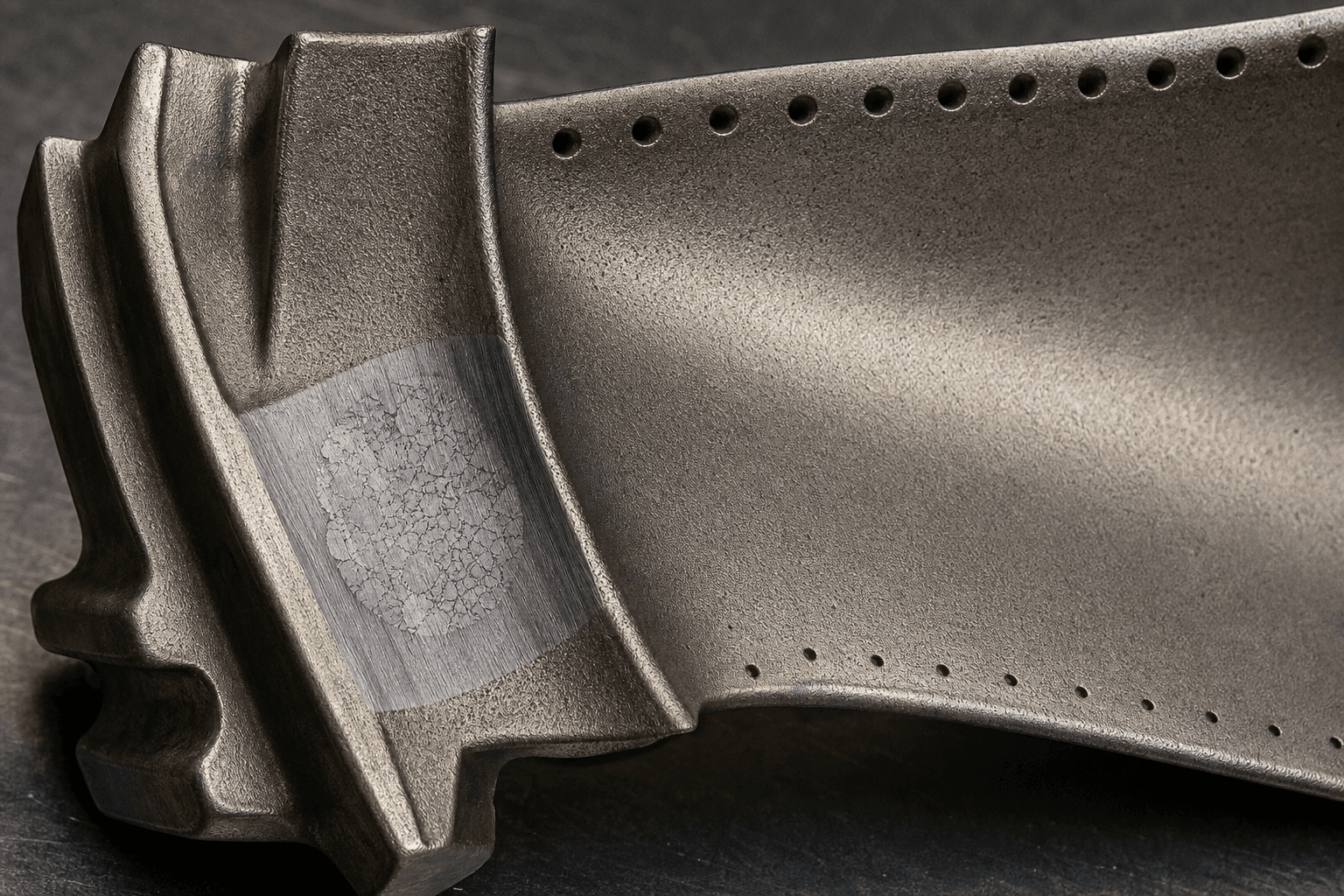
Result 1 — On a rotating E-class row, pour the IN738LC written on the last shop ticket
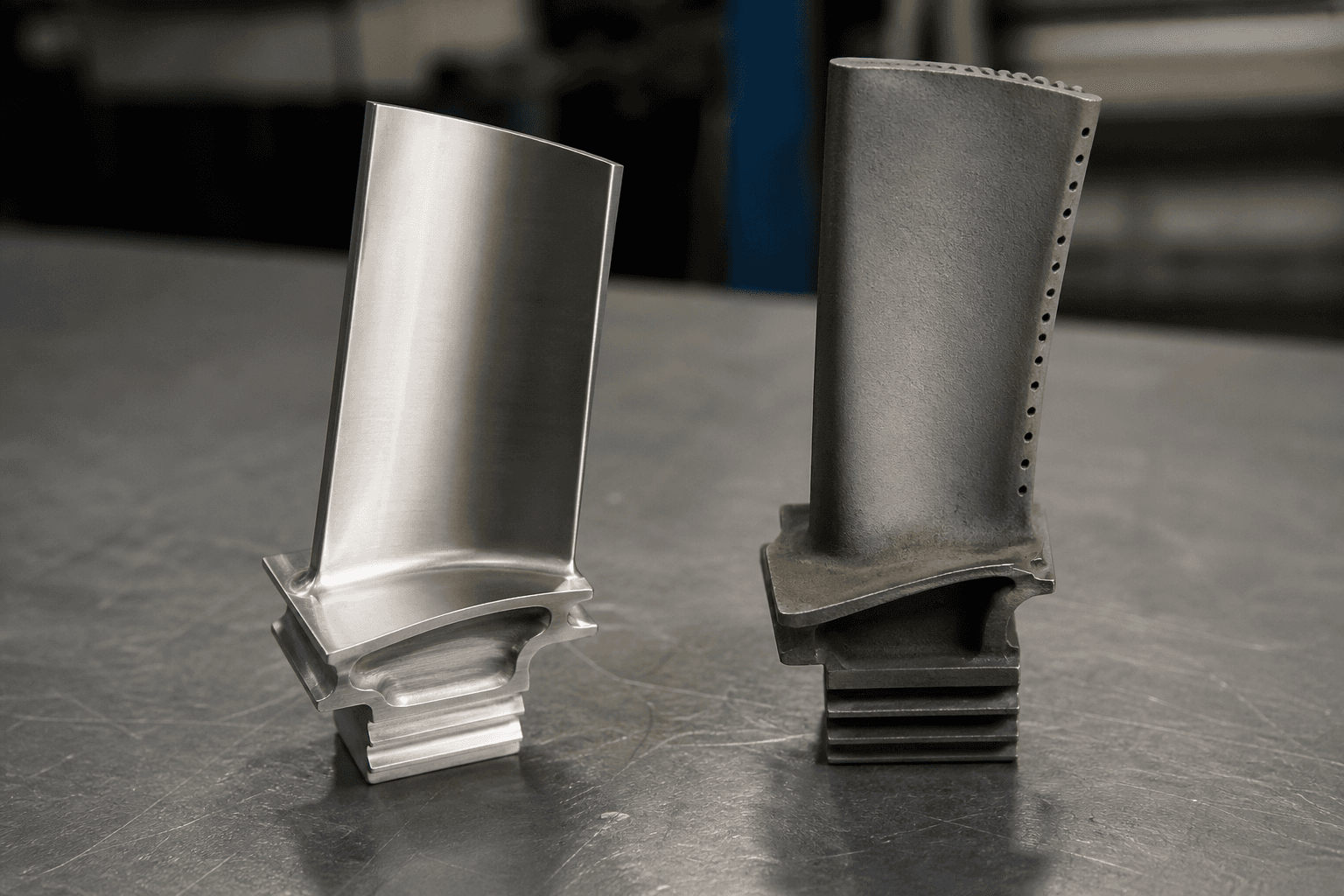
IN738LC is the low-carbon foundry variant of IN738. LC is not a marketing suffix you add to make a quote look more complete, and it is not a discount you drop to save a week. On a large share of rotating E-class first-stage and second-stage blades, the last shop ticket already wrote IN738LC because that is the chemistry the vacuum pour and the later heat treatment were built around. The carbon window changes how the foundry controls carbides; guessing it is how a heat fails the chemistry check. Equiaxed IN738LC is still a real hot-gas-path product: vacuum investment-cast, often HIP’d, then the fir-tree is machined and the airfoil is coated. It is not “the cheap version of a hotter alloy”.
Case A. A combined-cycle unit on Frame 9E sends first-stage buckets for new-make. The last shop ticket, still stapled to the crate, says IN738LC. Hours are high, the coating is gone, remaining wall is below a repair envelope. Euroturbine writes IN738LC vacuum pour, HIP if the specification for that row says so, root machine, coat, fluorescent penetrant, radiography, CMM. We do not “upgrade” the line to IN939 or to GTD111 because a salesman prefers a larger number. The quote names the grade in full, not the word Inconel.
Result 2 — If the paper says IN738 without LC, do not add the letters
IN738 without the LC letters is not automatically the same heat as IN738LC. If the last shop or the OEM note wrote IN738, that is the chemistry to match until a signed substitute exists. Adding LC to look thorough is how a pour misses the carbon window and fails the mill check. Dropping LC to chase a cheaper melt is the same failure in the other direction. Euroturbine copies the letters that are on the paper. We do not complete them from a catalogue heading.
Case B. An industrial Frame 9E station has a faded OEM note that says IN738, no LC. Purchasing wants the RFQ to say IN738LC “because that is what everyone pours”. Euroturbine does not add the letters. We quote IN738, ask for a chemistry certificate on the heat, and only move to LC if engineering writes the substitute with the carbon window. Until that paper exists, the foundry pours what the note said.
Result 3 — Order IN939 when that row was specified for it, not as a prettier 738
IN939 is a different nickel grade, not a prettier spelling of IN738. It is specified where the strength-versus-hot-corrosion balance of that row is not the same as a typical rotating 738 blade — including some stationary vanes. The heat treatment, the coating window and the remaining-life logic follow IN939, not the rotor next door. Writing IN738 on an IN939 line because both names contain nickel is how a plant buys a blade that cannot carry the corrosion case it was designed for.
Case C. A combined-cycle unit on V94.2 sends a first-stage nozzle segment. The last metallurgy note says IN939. The rotor buckets on the same outage are IN738LC. Euroturbine writes two lines: IN738LC for the rotating row, IN939 for the segment. We will not silently pour 738 into the nozzle because the site said “Inconel” on the phone. If the note is missing, a scrap airfoil goes for chemistry before anyone talks about a substitute.
Do not put GTD111 on the same disc in place of IN738 unless that row’s specification says so
GTD111 and Rene 80 sit on other rows as cousin nickel alloys. Each has its own process book: pour, HIP window, heat treatment, coating. They are not a free “better 738”. An airfoil that looks similar on the bench can still be the wrong metal for creep, for coating temperature, and for the disc slot it has to enter. Euroturbine will not change an IN738LC OEM number into GTD111 because a capability slide named both alloys. A documented substitute is a signed engineering paper. A wish is not.
Same disc does not mean same metal. The fir-tree that entered an IN738LC slot was cut for that grade’s heat treatment and coating window. Putting GTD111 on that same disc, against the same OEM number, changes creep strength, the temperature the coat can stand, and sometimes the machining allowance on the serrations. If engineering wants a substitute, they write the new grade, the new heat-treatment cycle, and the coating stack on a signed paper for that row. Until that paper exists, the foundry pours the grade that is already on the ticket.
Case D. Purchasing on a Frame 9E combined-cycle unit asks to “upgrade” first-stage buckets from IN738LC to GTD111 on the same RFQ, same OEM number, same outage date. Euroturbine refuses that sentence. We will quote IN738LC to the existing number, or we will open a separate engineering request for a substitute with heat-treatment and coating evidence. Until that request is signed, the foundry slot stays 738LC. Mixing the two names on one line is how a pretty, wrong blade arrives.
Do not copy the rotating-blade grade onto a stationary vane
Because a vane does not spin, centrifugal creep is not the life limiter. Oxidation, thermal fatigue, trailing-edge thinning and blocked cooling holes are. That is why cobalt-base alloys show up on many stationary rows even when the rotor blades next to them are IN738-class nickel. If the site said “Inconel” and the crate is a nozzle segment, do not assume the metal followed the rotor. Write rotating versus stationary on every line. Euroturbine will not silently swap a cobalt vane chemistry onto a 738 blade request, or the other way around.
Copying the rotor grade onto the vane line is how a plant pours nickel into a cobalt row, or cobalt into a 738 bucket. The two parts sit in the same case and share an outage week; they do not share a heat book. If the last shop note is missing, send one scrap segment for chemistry before anyone books a mould. Write rotating or stationary on the same line as the grade. That one word is cheaper than a crate of the wrong metal.
Case E. A combined-cycle unit on V94.2 opens the case. The store counted “پره” as one pile. Half the pile is rotating IN738LC buckets; half is cobalt-base nozzle segments. Euroturbine splits the RFQ into two OEM lines before anyone books a mould. Chemistry on one scrap segment confirms cobalt. The rotating line stays IN738LC. One word Inconel would have poured the wrong metal into half the crate.
A filled alloy request a buyer can copy
Copy this block and replace the brackets. Frame: MS9001E (Frame 9E). Stage: 1, rotating. Grade: IN738LC, copied from the last shop ticket dated [date], not guessed from a catalogue. OEM part number: [number on the blade or the drawing]. Quantity: one full row. Planned outage: [month year]. Hours and starts on this unit: [hours] / [starts]. Pour: vacuum investment-cast. HIP: yes or no, as the last certificate said. Root: fir-tree machined to the OEM stack-up. Coating: last stack written in full — for example MCrAlY bond coat plus atmospheric-plasma-spray ceramic — not the word coated. Inspection: fluorescent penetrant on the surface, radiography on a hollow stage-1, CMM of the fir-tree. Heat number and chemistry certificate with the crate. Rotating or stationary written on the same line as the grade.
Without those lines you have an alloy word, not a blade specification. Euroturbine prices grade, pour, HIP, machine, coat and inspection on the same page. If you only have a worn sample, chemistry is read before anyone talks about an upgrade. Send the OEM number, a photograph of the root, and any existing mill paper with the block above.
If the only specification on the paper is Inconel 738, you do not yet have a blade specification.
Frequently asked questions
Is Inconel 738 the same as IN738LC?
Not automatically. LC is the low-carbon foundry variant used on many rotating blades. If the last shop or the OEM note wrote LC, write LC. If it wrote IN738 without LC, do not add the letters to make the quote look more complete. Guessing carbon is how a heat fails the chemistry check.
Can a vane be cobalt if the site said Inconel?
Yes. Stationary parts are often cobalt-base because their life is limited by oxidation and thermal fatigue, not by centrifugal creep. That is why rotating versus stationary belongs on the RFQ before anyone copies the rotor grade onto the nozzle line.
Does Euroturbine pour 738?
Through the European foundry route, to the grade that row needs — IN738, IN738LC or IN939 — with heat and inspection certificates. We do not pour a cousin alloy such as GTD111 against a 738 number unless engineering has written the substitute.
Related Euroturbine pages
Send the grade in full, not only the word Inconel
Write IN738, IN738LC or IN939, the stage, rotating or stationary, and the OEM number. Euroturbine will match the pour to the row.
Request a quoteMore articles

Last updated: August 29, 2026